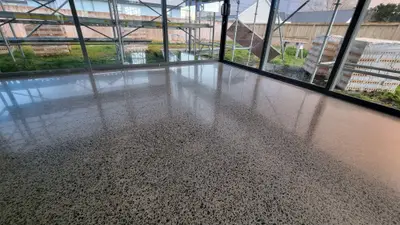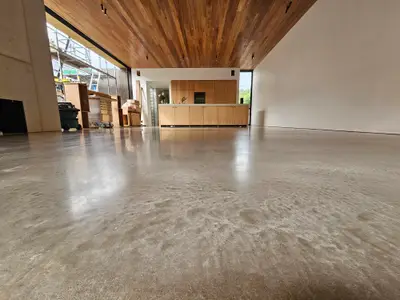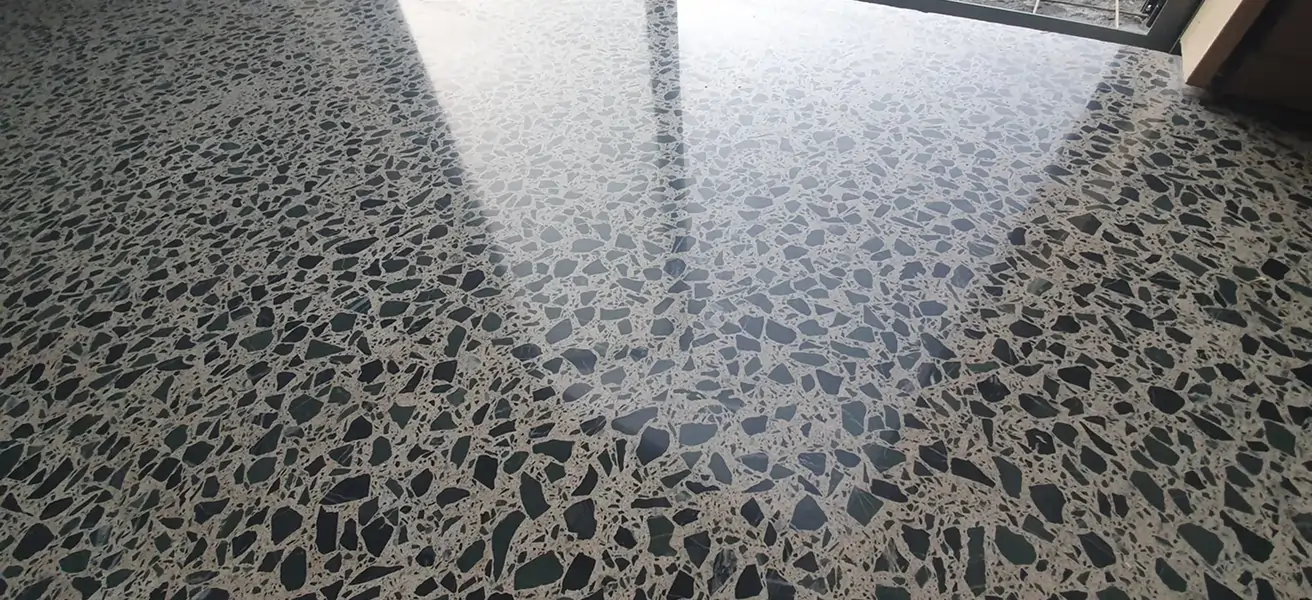

Grind and seal is a topical coating applied to ground concrete. Mechanical polishing (sometimes called Hiperfloor, which is a brand name for this process) hardens the concrete itself - no coating to peel or wear off. For long-term value in a home, mechanical polishing is the better system. But grind and seal has its place too, and the right choice depends on your budget, the space, and how long you want the floor to last.
> A note on terminology: "Hiperfloor" is a brand name for mechanically polished concrete. Other branded systems exist for the same process. Throughout this article, we use "mechanically polished concrete" to refer to the process regardless of which specific system is used.

Both systems start the same way - with diamond grinding. The difference is what happens after the grinding is done. One applies a coating on top. The other continues grinding through progressively finer stages until the concrete itself becomes the finished surface. This guide breaks down exactly how each system works, what it costs, and which one makes sense for your project.
The Key Difference
Grind and Seal
The concrete surface is ground to create a profile (texture for the sealer to grip). Then a topical sealer or coating is applied on top of the concrete. The coating sits ON the surface - it is not part of the concrete.
Think of it like painting a timber deck. The paint protects and finishes the surface, but over time it wears, peels, and needs reapplication.
The process: 1. Grind the surface with coarse diamonds to create a profile 2. Clean and prepare the surface 3. Apply a topical sealer (acrylic, polyurethane, or similar coating) 4. Allow to cure
Lifespan of the coating: 5-10 years before recoating is needed, depending on traffic.
Mechanically Polished Concrete
Instead of applying a coating, the concrete is ground through multiple stages - from coarse diamond tooling (around 40 grit) through to extremely fine tooling (up to 3000 grit). Between stages, a lithium densifier is applied.
The densifier chemically reacts with the calcium hydroxide in the concrete to form calcium silicate hydrate - essentially turning the surface into a harder, denser version of itself. The finish IS the concrete. There is nothing on top to wear off.
The process: 1. Coarse grinding (40-80 grit) to flatten and expose aggregate 2. Medium grinding (100-200 grit) to refine the surface 3. Densifier application - lithium silicate penetrates and hardens the concrete 4. Fine grinding (400-800 grit) to develop sheen 5. Polish grinding (1500-3000 grit) for final gloss level
Lifespan: 20+ years with good maintenance. The concrete itself is the finish - it will dull over time with use but can be rebuffed to restore the shine.
Side-by-Side Comparison
| Feature | Grind and Seal | Mechanically Polished Concrete |
|---|---|---|
| Process | Grind + apply topical coating | Multi-stage diamond grinding + lithium densifier |
| What creates the finish | A coating sitting on top of concrete | The concrete surface itself, hardened and refined |
| Durability | Coating wears over time, especially in high-traffic areas | Extremely durable - gets harder with age |
| Lifespan | 5-10 years before recoating | 20+ years with good maintenance |
| Maintenance | Regular mopping + periodic strip and reseal ($50-$80/m2) | Regular mopping + periodic rebuff to restore shine ($30-$50/m2) |
| Upfront cost | Lower - fewer grinding stages | Higher - more grinding stages + densifier |
| Lifetime cost | Higher - recoating every 5-10 years adds up | Lower - no recoating needed |
| Appearance | Varies by sealer type - can look slightly plastic | Natural concrete finish with true depth and clarity |
| Slip resistance | Depends on sealer type | Good - matte and satin finishes have natural grip |
| Stain resistance | Good when coating is fresh, decreases as it wears | Excellent - densified surface resists penetration |
| Best for | Garages, outdoor areas, budget projects, temporary spaces | Homes, retail, commercial, anywhere you want a long-term floor |
| Recoat needed? | Yes - every 5-10 years | No - just periodic rebuff |
| Can be upgraded later? | Yes - strip coating, then mechanically polish | Already the highest tier |
When Grind and Seal Makes Sense
Grind and seal is not a bad system. It is a practical, cost-effective option for the right applications.

Garages and workshops. These are high-abuse spaces where the floor takes a beating from tools, chemicals, and heavy objects. A grind and seal finish protects the concrete at a lower upfront cost, and recoating every few years is a minor job.
Outdoor areas. Patios, paths, and pool surrounds are exposed to weather, UV, and moisture. A sealed finish is the standard approach for outdoor concrete. Full mechanical polishing is typically reserved for interior floors.
Budget projects. If the upfront cost of mechanical polishing is outside your budget, grind and seal gives you a clean, finished concrete floor at a lower price point. You can always upgrade to a mechanical polish later by stripping the coating and starting the polishing process.
Temporary or short-term spaces. Commercial tenancies, pop-up retail, or spaces that will be refitted in a few years - grind and seal delivers a good-looking floor without the investment of a long-term system.
When Mechanical Polishing Is Worth It
For any floor you plan to live with long-term, mechanical polishing is the better investment.

Homes. This is the most common application. A mechanically polished floor in your living area, kitchen, or hallway will last decades with minimal care. There is no coating to maintain, no recoating appointments to schedule. The surface will dull gradually with foot traffic over time - similar to timber or tiles - but a periodic rebuff restores the shine.
Commercial spaces with high traffic. Retail stores, supermarkets, showrooms, and hospitality venues benefit from a floor that does not need periodic shutdowns for recoating. The reduced maintenance alone pays back the upfront cost difference within a few years.
Anywhere you value low maintenance. If you want a floor you can mop and forget about for years at a time, mechanical polishing is the answer. The only maintenance beyond regular cleaning is an occasional rebuff every few years to refresh the shine.
The Cost Comparison
The upfront cost difference between grind and seal and mechanical polishing is real but often smaller than people expect.
| System | Upfront cost per m2 (+ GST) | Maintenance cost | 10-year total (100m2 floor) |
|---|---|---|---|
| Grind and seal | $40-$70 | Strip and reseal $50-$80/m2 every 5-10 years | $9,000-$15,000 |
| Mechanical polish | $80-$130 | Rebuff $30-$50/m2 every 3-5 years | $11,000-$18,000 |
Over 10 years, the gap narrows significantly once recoating costs are factored in. Over 20 years, mechanical polishing is typically cheaper because grind and seal recoating costs continue to accumulate while the mechanically polished floor only needs periodic rebuffs.
For a full breakdown of polished concrete pricing in Auckland, see our pricing guide.
The Appearance Difference
This is where many homeowners notice the biggest difference.

Grind and seal can look slightly plastic or filmy, especially as the coating ages. Some high-quality sealers produce a natural look, but there is always a layer between your eye and the concrete underneath. Over time, the coating can yellow (particularly solvent-based sealers) or develop wear patterns in high-traffic areas.
Mechanically polished concrete has a depth and clarity that coatings cannot replicate. Because you are looking directly at the concrete surface - refined through thousands of grit stages - the aggregate, colour, and texture are completely natural. The reflections in a high-gloss mechanical polish are sharp and clear, not diffused through a coating layer.
For more on the different looks you can achieve with mechanical polishing, read our guide on salt and pepper finishes.
A Note on Coatings
Grind and seal and mechanical polishing are the two main systems for concrete floors. There are other coating options on the market - including various proprietary blends and multi-coat systems - but they all share the same fundamental limitation: any topical coating will eventually wear and need replacement.
The question is not whether a coating is good or bad. It is whether you want a floor that needs periodic maintenance or one that does not.
How Do I Know Which System I Have?
If you have an existing polished concrete floor and are not sure which system was used, there is a simple test. Place a few drops of water on the surface.
- Grind and seal: The water sits on top and beads. The coating acts as a barrier.
- Mechanically polished: The water may sit briefly but will eventually absorb slightly into the surface (though densified concrete absorbs very slowly).
You can also look at the edges and corners. Coatings tend to show wear patterns, peeling, or buildup in these areas over time. A mechanically polished floor will look consistent right to the edges.
If your floor has a coating that is wearing or peeling, DSC can strip it and upgrade to a mechanical polish. This is a common job for older grind and seal floors that are due for recoating - rather than recoat, many homeowners choose to upgrade to mechanical polishing as a long-term investment. To understand how long a mechanically polished floor lasts, read our longevity guide.
Frequently Asked Questions
How much does grind and seal cost compared to mechanical polishing?
Grind and seal typically costs $40-$70 per m2 + GST for residential jobs. Mechanical polishing ranges from $80-$130 per m2 + GST depending on floor size and finish level. The upfront difference is moderate, but grind and seal requires stripping and resealing every 5-10 years at $50-$80 per m2, so the lifetime cost often favours mechanical polishing.
Which is better for a garage?
Grind and seal is generally the better choice for garages. Garages take heavy abuse from tools, chemicals, tyre marks, and heavy items being dragged across the surface. A sealed finish provides solid protection at a lower price, and recoating every few years is a straightforward job. That said, mechanical polishing works in garages too if you want a long-term, low-maintenance solution.
Can you convert a grind and seal floor to a mechanical polish?
Yes. The existing coating is stripped (either chemically or by grinding it off), and the standard mechanical polishing process begins from there. This is a common upgrade path for homeowners with ageing grind and seal floors who want to move to a low-maintenance finish rather than recoat again.
How do I know which system my floor has?
Place a few drops of water on the surface. If the water beads and sits on top, you likely have a sealed (coated) floor. If the water sits flat and absorbs very slowly, it is more likely a mechanically polished floor. You can also check the edges and corners - coatings tend to show wear patterns or peeling in these areas.
Does DSC do both grind and seal and mechanical polishing?
Yes. Diamond Shine Concrete offers both systems and can advise on which is the right fit based on your space, budget, and how you plan to use the floor. For most homes, DSC recommends mechanical polishing because it eliminates ongoing recoating, but grind and seal is a solid choice for garages, outdoor areas, and budget-focused projects. Contact us at 021 414 082 or hello@diamondshineconcrete.co.nz for a free consultation.