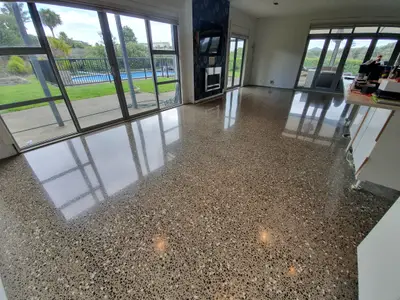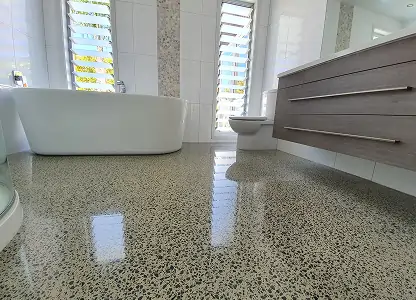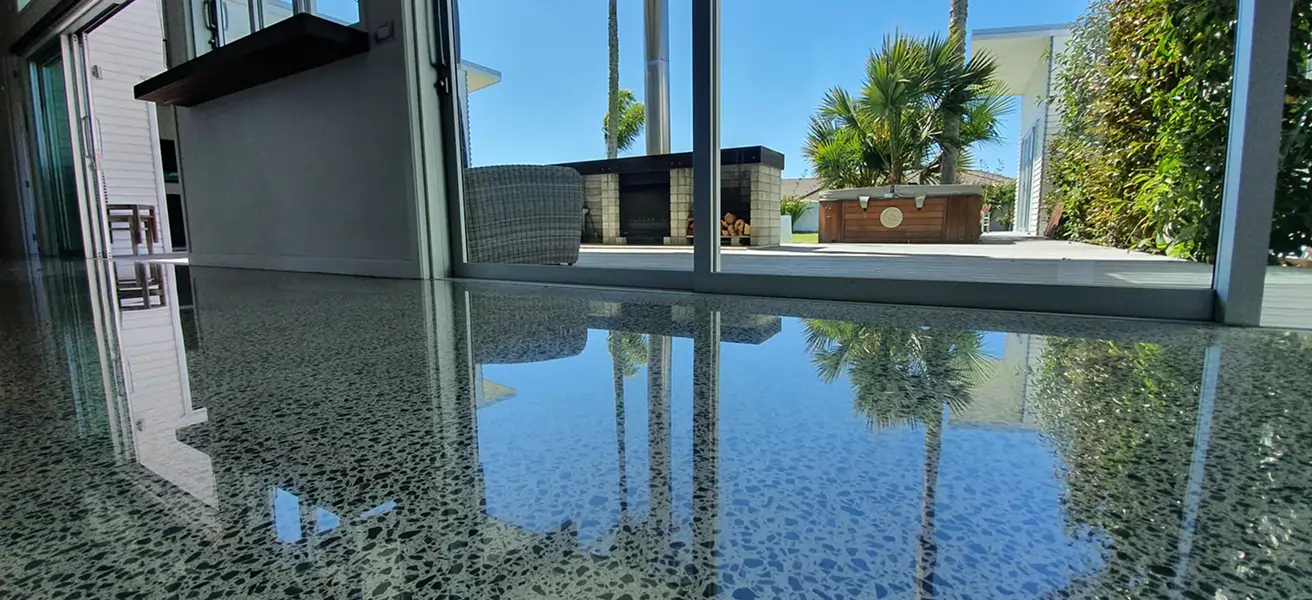

No, polished concrete is not inherently slippery. In dry conditions, a polished concrete floor provides traction comparable to ceramic tiles or sealed timber. The concern usually comes from the way high-gloss finishes look - they appear slick, but the surface texture still provides grip. With the right finish and maintenance, polished concrete meets New Zealand building standards for slip resistance in both residential and commercial settings.

Why Polished Concrete Looks More Slippery Than It Is
People associate shine with slipperiness. A mirror-finish floor looks like it should be slick, the same way a wet tile floor looks dangerous. But the gloss on a polished concrete floor comes from mechanically refining the surface with progressively finer diamond pads - not from applying a slippery coating on top.
The polishing process also includes densifier application. Densifiers are liquid hardeners (typically lithium silicate) that penetrate the concrete and react chemically with the slab. This hardens the surface, closes the pores, and actually improves traction at a microscopic level. The result is a floor that resists dusting and staining while maintaining a naturally textured surface underneath the shine.
Unlike coated floors - where a film sits on top and can become slick when wet - a mechanically polished floor has no coating to wear off or become slippery over time.
NZ Building Code and Slip Resistance Standards
In New Zealand, slip resistance is measured against AS/NZS 4586, the standard used across Australia and New Zealand. This standard assigns two types of ratings depending on the test method.
P-ratings (wet pendulum test) measure the slip resistance of a floor when wet. This is the most commonly referenced rating for indoor flooring in New Zealand.
R-ratings (ramp test) measure slip resistance on inclined surfaces and are more commonly used in commercial and industrial settings.
For most residential applications in New Zealand, a P2 or P3 rating is adequate. Polished concrete - even at a high-gloss level - typically achieves P2 or higher when dry. The key variable is the finish level and whether the floor is wet.
Slip Resistance by Finish Type
Not all polished concrete is the same. The finish you choose directly affects both the look and the grip level. Here is how the three main finish types compare.

The matte (honed) finish retains more of the concrete's natural texture, which gives it the best grip in both dry and wet conditions. However, there is a trade-off worth knowing about - matte finishes are more susceptible to staining and wear than higher sheen levels. The less refined the surface, the more open the pores, which means spills can mark more easily and foot traffic shows sooner.
Matte finishes are also quicker and easier to achieve, which is typically reflected in the pricing.
The satin or semi-gloss finish is the sweet spot for most Auckland residential jobs - and it is the finish we recommend most often. It strikes a balance between visual appeal, everyday practicality, and durability. You get enough sheen to resist staining and wear while keeping good slip resistance in normal conditions.

The high-gloss finish is the one that raises the most questions. We will be honest - a high-gloss polished floor is more slippery when wet than a matte or satin finish. That is a fact. However, in dry conditions, it still provides adequate traction and meets standard residential slip requirements. Where it needs more attention is in areas prone to water - spills near the kitchen sink, entranceways where wet shoes track in, or near sliding doors.
What About Wet Conditions?
This is where the honest conversation matters. Any hard flooring surface - tiles, timber, vinyl, polished concrete - becomes more slippery when wet. Polished concrete is no exception.
The difference between finishes is most noticeable when the floor is wet.
If your home includes wet-prone areas like bathrooms or laundries, a satin finish across the whole floor gives you the best combination of slip resistance and stain resistance. Use mats and rugs in specific wet zones rather than specifying a different finish level for each room - in practice, almost all homeowners choose a single consistent finish throughout.
In commercial settings - retail stores, cafes, office lobbies - the NZ Building Code has stricter requirements. Any floor in a public space must meet the relevant P-rating for that area. We advise on the right finish level for commercial compliance and can provide slip test certificates where required.
What Diamond Shine Concrete Does for Grip
We do not just polish and leave. Every job includes a conversation about where the floor sits, how it will be used, and what finish level makes sense for your situation.
Densifier application - Every polished floor we complete receives a lithium silicate densifier. This hardens the surface and improves its resistance to both wear and slipping. It is a standard part of our process, not an optional extra.
Finish recommendation - We will always be upfront about which finish suits your space. For most homes, semi-gloss is the best all-round choice - it balances look, durability, and grip. We discuss the options during the quoting stage so you know exactly what to expect.

Practical Tips for Homeowners
Even with the right finish, a few simple habits keep your polished concrete floor safe.
- Clean spills quickly - Standing water on any hard floor increases slip risk. A quick mop or cloth is all it takes.
- Use rugs or mats at entry points - Doormats at entrances catch wet shoes before they reach the polished surface. This applies to any hard flooring, not just concrete.
- Avoid silicone-based cleaners - Some cleaning products leave a residue that makes floors more slippery over time. Use a pH-neutral cleaner designed for polished concrete or simply warm water and a microfibre mop.
- Re-apply densifier periodically - For high-traffic commercial floors, a maintenance application of densifier every few years helps maintain both the finish and the grip.
How Does Polished Concrete Compare to Other Flooring for Slip Resistance?
Polished concrete holds up well against every common flooring alternative. Its biggest advantage is consistency - a mechanically polished surface does not degrade the way coatings, glazes, and oil finishes do. The grip you get on day one is essentially the grip you get in year ten.
Frequently Asked Questions
Is polished concrete safe for children and elderly family members?
Yes. A satin (semi-gloss) finish provides excellent traction in dry conditions and good traction when damp, meeting P2-P3 slip resistance ratings - comparable to or better than most residential tile installations. For households with young children or elderly family members, we recommend a consistent satin finish across the whole floor paired with mats in wet zones for extra grip.
Is polished concrete slippery in wet areas like bathrooms?
Polished concrete can be used in bathrooms. A satin finish provides good slip resistance while resisting staining better than matte. We do not recommend a high-gloss finish in areas where standing water is common. In practice, most homeowners choose a consistent satin finish throughout the home and use mats in wet areas for extra grip rather than specifying a different finish for each room.
How much does polished concrete cost in Auckland?
Most residential polished concrete jobs in Auckland sit around $100 per m2 + GST for a typical 50-70m2 area. Smaller floors have a minimum charge of $2,250 + GST. The finish type (matte, satin, or high gloss) does affect the price - higher gloss levels require more polishing stages. For a detailed breakdown, read our full pricing guide.
Does the slip resistance change over time?
No. Unlike coated floors where the surface film wears off and becomes unpredictable, a mechanically polished concrete floor has no coating. The slip resistance stays consistent over the life of the floor. Periodic densifier maintenance on high-traffic commercial floors can actually improve grip over time.
What is a P-rating?
P-ratings are part of the AS/NZS 4586 standard used in New Zealand and Australia to classify floor slip resistance. They range from P1 (low) to P5 (highest). The rating is determined by a wet pendulum test that measures friction. Most residential floors require P2 or above. Polished concrete in a matte or satin finish typically meets P2-P3.
What finish do you recommend for most homes?
Semi-gloss (satin) is the sweet spot for most residential jobs. It gives you a clean, modern look with good stain resistance and solid grip in normal conditions. High gloss looks stunning but needs more attention around water. Matte has the best grip but is more prone to staining and wear. Most of our Auckland homeowners go with a consistent semi-gloss finish across the whole floor.