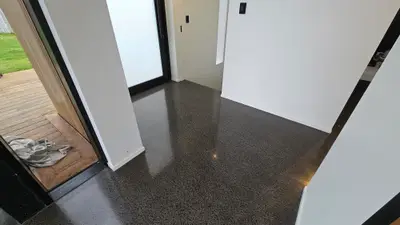
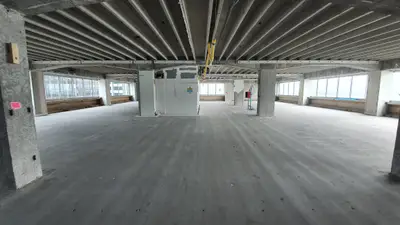
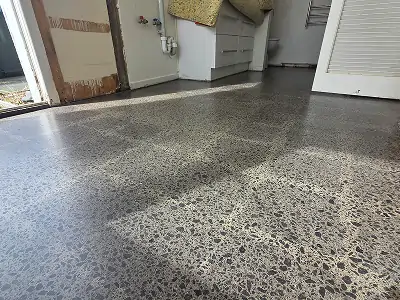
Yes, most existing concrete floors over 10 years old can be polished. The slab does not need to be new or specially prepared - it just needs to be structurally sound. We have polished concrete floors across Auckland that were poured in the 1970s, 1980s, and 1990s, and the results are often better than homeowners expect.

The real question is not whether an old floor can be polished - it is what finish you should realistically expect. Here is what we have learned from hundreds of renovation projects across Auckland.
What We Find Under Old Flooring
Most homeowners contact us after pulling up carpet, tiles, or vinyl and discovering a concrete slab underneath. What we find determines the approach and the realistic finish.
| What is on the slab | What we typically find underneath | Grind level needed |
|---|---|---|
| Carpet | Tack strip holes (3-4mm deep), adhesive patches | Medium to heavy |
| Tiles | Tile adhesive residue, ghosting patterns | Medium to heavy |
| Vinyl | Adhesive (often black bitumen on older homes) | Heavy |
| Nothing (bare slab) | Surface wear, minor cracking | Light to medium |
The key takeaway is that most old slabs need a medium-to-heavy grind - not a light salt-and-pepper finish. A light grind will not remove adhesive properly (it smears and burns) and will not blend the tack strip damage or surface imperfections that come with age.
What Affects the Finish on an Old Floor
Slab condition
Older slabs were not poured with polishing in mind. They may have uneven surfaces, small cracks, or variations in aggregate density. A heavier grind helps level these out and creates a more consistent look.
Most old slabs are surprisingly consistent once ground to the right depth. The aggregate exposure gives a natural, characterful finish that many homeowners prefer over a perfectly uniform new slab.

Adhesive and glue removal
If carpet or vinyl adhesive is still on the slab, it must be ground off completely. Light grinding smears carpet adhesive and burns it into the surface. A heavier cut removes it cleanly and exposes fresh concrete underneath.
This is one of the most common reasons a salt-and-pepper finish is not achievable on renovation jobs. The grind depth needed to remove adhesive goes past the light-grind zone.
Tack strip holes
Carpet tack strips leave rows of small holes around every room perimeter, typically 3-4mm deep. These are filled during the polishing process, but a heavier grind makes them much less noticeable by blending them into the stone exposure.
Homeowners can save some time (and cost) by pulling up the tack strips themselves before we arrive. The holes will be there either way and will be filled during prep.
Cracks
Cracks in old concrete are normal. Hairline cracks are cosmetic and often become a feature of the floor. Larger cracks are filled with colour-matched filler before grinding. They will still be visible up close but blend into the overall look of the floor.
Structural cracks - where the slab has shifted or separated significantly - are a different issue and may need assessment before polishing.
What Finish to Expect
On a 10+ year old floor, here is a realistic expectation.
Grind level. Medium to heavy. This exposes more stone aggregate than a light grind but creates a more consistent, attractive finish on older slabs. True salt-and-pepper (lightest grind) is rarely achievable because older slabs are usually not flat enough, and any adhesive removal pushes the grind deeper.
Sheen. We recommend semi-gloss (satin) as the single finish across the entire floor. It is the best balance of appearance and practicality - it hides minor imperfections better than high-gloss and resists staining better than matte.
Character. Old concrete has natural colour variation that gives polished floors a unique, characterful look. No two old slabs polish the same way, and that is part of the appeal.

The Process for Old Floors
The process for polishing an old floor is the same as any other mechanically polished concrete job. DSC uses the same approach across the entire floor - no special treatment for edges, transitions, or problem areas.
1. Remove existing flooring (if not already done) 2. Assess the slab - check for structural issues, adhesive type, overall flatness 3. Grind - progressively finer diamond grinding starting at a coarser grit to remove adhesive and level the surface 4. Fill - cracks, tack strip holes, and any voids filled with colour-matched epoxy 5. Densify - chemical densifier applied to harden the surface 6. Polish - fine diamond grinding to achieve the chosen sheen level 7. Seal - final protective treatment
A typical residential renovation floor (50-70m2) takes 2-3 days.
Pricing for Old Floor Polishing
Renovation and carpet removal jobs typically fall in the higher end of residential pricing because of the additional prep work.
| Floor area | Price per m2 (+ GST) |
|---|---|
| Under 20m2 | $2,250 flat rate |
| 50-70m2 (average residential) | $90-$120 |
| 70-200m2 | $80-$100 |
| Carpet removal / renovation | $90-$120 |
The extra cost compared to a new slab reflects the adhesive removal, additional grinding passes, and crack filling. For a full pricing breakdown, see our polished concrete cost guide.
When an Old Floor Cannot Be Polished
Not every old slab is a candidate. These situations may rule out polishing:
Severe structural damage. If the slab has heaved, shifted, or has large sections that have broken apart, polishing will not fix the underlying issue.
Moisture problems. A slab with active moisture migration (rising damp) can cause coating adhesion issues in grind-and-seal systems. Mechanically polished concrete handles moisture better than coated systems, but persistent damp should be investigated before committing.
Very thin slabs. Some older buildings have slabs thinner than 75mm. A heavy grind on a very thin slab is not advisable.
These situations are rare. We assess every floor before quoting and will tell you honestly if polishing is not the right option.
Frequently Asked Questions
How much does it cost to polish an old concrete floor in Auckland?
For a typical residential renovation (50-70m2), expect $90-$120 per m2 + GST. Larger floors cost less per square metre. See our full pricing guide for detailed ranges.
Can you get a salt-and-pepper finish on an old floor?
Rarely. True salt-and-pepper is the lightest grind level, and most old floors need a medium-to-heavy grind to remove adhesive, level the surface, and blend imperfections. A medium grind still looks great - it just exposes more stone aggregate. Read more in our salt-and-pepper finish guide.
Do the carpet tack strip holes show after polishing?
They are filled with colour-matched filler during prep. On a heavier grind, the surrounding stone exposure blends them in well. Up close, you may see the filled holes, but from standing height they are part of the floor's natural character.
How long does it take to polish an old floor?
A typical 50-70m2 residential floor takes 2-3 days. Larger floors or floors with extensive adhesive may take an extra day.
Will the cracks in my old floor show after polishing?
Yes - cracks are filled but remain visible. Hairline cracks become a natural feature. Larger cracks are filled with colour-matched epoxy and blend into the overall look.
How long will a polished old floor last?
The same as any mechanically polished concrete floor - 20+ years with good maintenance. The age of the slab does not affect how long the polished finish lasts.