

Polished concrete is the most practical floor surface for most Auckland warehouses. The grinding and polishing process hardens the slab at a molecular level - no coating to peel, no dust, and a floor that lasts 20+ years with good maintenance. For most warehouses, the answer is yes.
The honest cons: upfront grinding cost, downtime during installation, and existing cracks will remain visible. This article covers both sides and the real NZ commercial pricing.

Polished Concrete vs Epoxy Coating in a Warehouse
The most common comparison for warehouse floors is mechanically polished concrete versus an epoxy coating. Over a 10-year operational period, the two are very different in total cost and maintenance demand.
| Feature | Mechanically polished concrete | Epoxy coating |
|---|---|---|
| Lifespan | 20+ years with good maintenance | 3-7 years before recoat |
| Forklift traffic rating | Yes - no coating to damage | Degrades under hard wheels over time |
| Maintenance cycle | Rebuff every 3-5 years | Strip and recoat every 3-5 years |
| Downtime for maintenance | Hours (rebuff overnight) | 48-72 hours (coat + cure, floor unusable) |
| Concrete dust | Eliminated (densifier hardens surface) | Reduced but not eliminated |
| Peel or delamination risk | None (no coating exists) | Yes - common in high-traffic areas |
| Appearance over time | Improves with traffic (burnishing effect) | Yellows and scratches under UV and wear |
The upfront cost gap between polished and epoxy narrows once you factor in the first recoat cycle. For any warehouse expecting to operate the same floor for more than five years, mechanically polished concrete is the lower total cost option.
Why Warehouses Choose Mechanically Polished Concrete
No coating to peel or delaminate
Epoxy coatings sit on top of the concrete. Forklift tyres, pallet jacks, and point loading from racking feet stress the bond between coating and slab. In a working warehouse, peeling typically begins within 3-5 years at seams, turning areas, and high-traffic lanes.
Mechanically polished concrete has no coating. The grinding and polishing process works into the slab itself, using a lithium densifier to harden the surface at a molecular level. There is nothing to peel, chip, or delaminate. Forklift traffic burnishes the surface rather than degrading it.
Dust elimination
Raw or lightly sealed concrete sheds fine dust as the surface slowly degrades. This settles on racking, product, and machinery - a hygiene issue in food-grade facilities and a maintenance problem everywhere else. The densifier used in mechanically polished concrete chemically hardens the slab and stops this shedding. Operators who have switched report a significant reduction in dust across racking and product.
Reflectivity reduces lighting costs
A polished concrete floor reflects overhead fluorescent or LED panels back into the space rather than absorbing light. For a warehouse with significant lighting running costs, this is a measurable operational saving over the life of the floor. A satin to semi-gloss finish provides good reflectivity; higher-gloss levels maximise light return in spaces with minimal natural light.

Low maintenance and minimal downtime
Mechanically polished concrete maintenance is a rebuff - done overnight or during a scheduled closure. The floor is operational immediately afterward. No curing time, no fumes, no sections roped off. Epoxy recoating, by comparison, requires 48-72 hours minimum before the floor can be used again.
For more on the long-term cost case across commercial applications, read our article on how polished concrete reduces maintenance costs in commercial spaces.
The Honest Cons
Cracks and construction joints telegraph
Mechanically polished concrete does not hide the slab underneath - it reveals it. Existing cracks, control joints, and any patching or repair work in the slab will remain visible in the finished floor. For a warehouse where aesthetics are secondary, this is often irrelevant. For a distribution centre fitout with a show-quality front office, it is worth assessing the slab condition carefully before committing to a polished finish.
DSC carries out a sample grind on arrival so you can see exactly how the slab responds before work begins. If the slab condition is poor - heavy cracking, significant patching, or major variation - we will tell you before committing to a finish that may not meet expectations.
Upfront grind cost and staging
The initial grinding and polishing process is a significant upfront investment, particularly for large warehouse floors. Smaller commercial spaces in the 200-500m2 range cost more per square metre than large warehouse floors, but even at the lowest commercial tier the total project cost for a 5,000m2 facility is substantial.
The flip side is that you do not pay that cost again for 20+ years. The rebuff cycle every 3-5 years is a fraction of the original installation cost.
Operational downtime during installation
Polishing a large warehouse floor requires machinery access and cannot be done with racking in place. This means either staging the work in sections or scheduling a planned shutdown. Both are manageable with coordination, and DSC has experience phasing large commercial installs to keep operations running. It requires advance planning, unlike a coating that can be applied to small patches independently.
Wet zones and drainage areas
For wash-down bays, cool store entries, and loading areas with drainage channels, DSC specifies a heavier grind to increase surface micro-texture. All finish levels pass NZ slip compliance standards - the lever for wet zones is grind depth, not additives or topical treatments.
Slip Compliance for Warehouses
Any commercial floor in NZ must meet AS/NZS 4586 slip resistance requirements. This is especially relevant for warehouses with forklift pedestrian crossings, wet zones, and loading areas where water ingress is common.
Mechanically polished concrete meets NZ Building Code requirements across all finish levels. DSC advises on the appropriate finish level and grind depth for each zone and can provide slip test certification where required. For a detailed breakdown of slip ratings and finish types, read our guide on slip ratings and polished concrete explained.
Commercial Pricing for Warehouse Floors in Auckland
Warehouse floors are priced in the commercial tiers. The large, open, obstacle-free layouts typical of warehouses are the most efficient environments to work in, which is reflected in the pricing.
| Floor size | Price per m2 (+ GST) | Typical warehouse application |
|---|---|---|
| 200-500m2 | $60-$80 | Small storage facility, workshops |
| 500-1,000m2 | $50-$70 | Medium warehouse, distribution annexe |
| 1,000m2+ | $45-$65 | Large warehouse, distribution centre |
These rates are for mechanically polished concrete - the process that produces a long-lasting, no-coating-required floor surface that lasts 20+ years with good maintenance. For our full commercial polishing service, sectors we cover, and what to expect from a large-format project, see our commercial concrete polishing service.
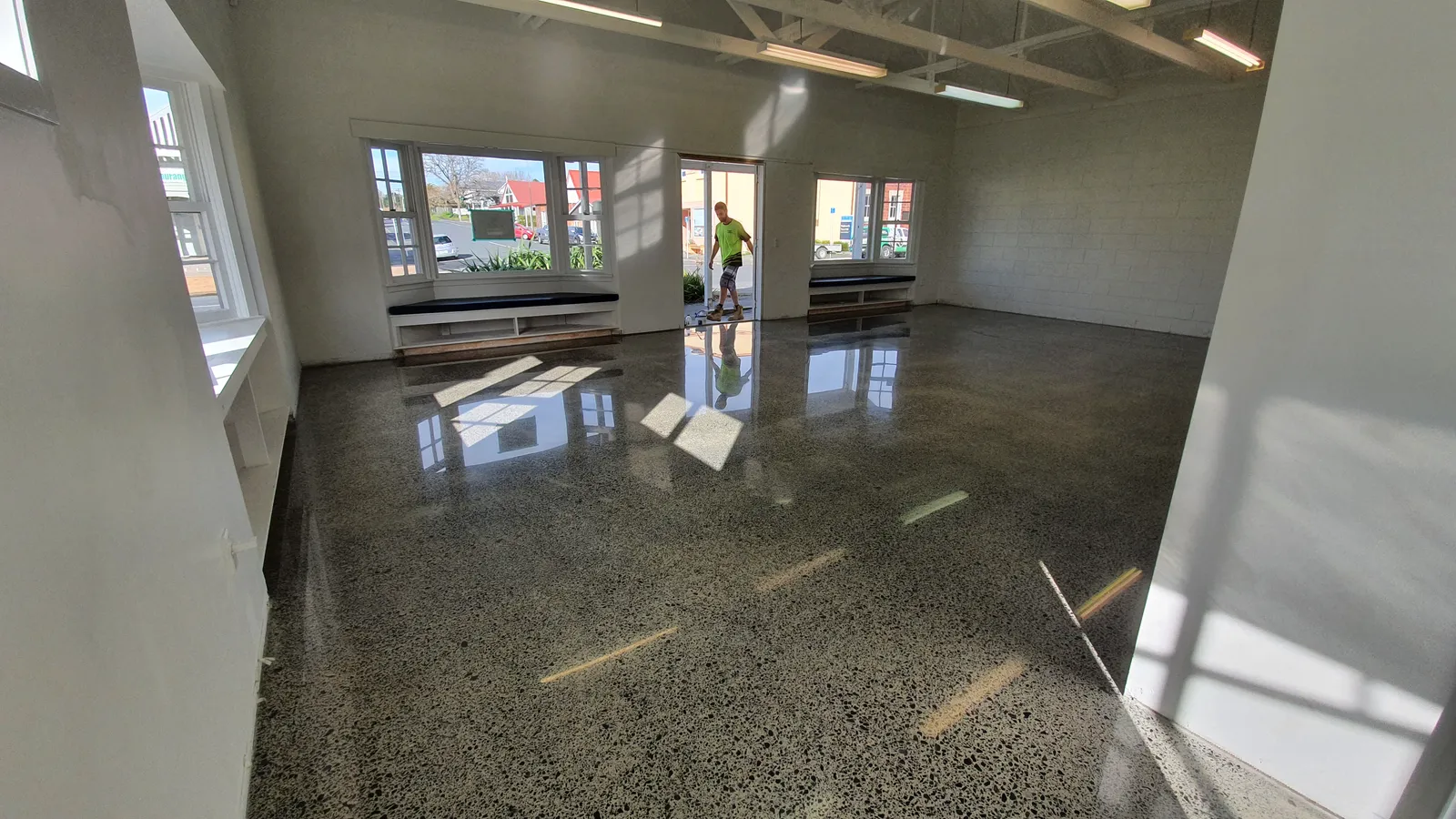
For residential pricing comparison, see our full polished concrete cost guide.
What to Look For in a Warehouse Floor Assessment
Before committing to a polished concrete specification, a good contractor will assess:
Slab condition. Older slabs, heavy patching, and significant cracking need honest evaluation. DSC carries out a sample grind on arrival so you see the result before any commitment is made.
Existing coatings. An epoxy or sealant on the slab must be removed before grinding. This adds to the project scope and should be included in the quote.
Operational staging. DSC can work in zones while the rest of the warehouse remains operational - the project schedule is part of the scope.
Zone specifications. Wet areas and heavy-use lanes may need a heavier grind. DSC advises on the right grind depth for each area before work starts.

Frequently Asked Questions
Q: How much does polished concrete cost for a warehouse in Auckland?
Warehouse floors are priced in the commercial tiers. For floors 200-500m2 the rate is $60-$80 per m2 + GST. For 500-1,000m2 the rate drops to $50-$70 per m2 + GST. For large-format floors of 1,000m2 or more, the rate is $45-$65 per m2 + GST. These are for mechanically polished concrete. Get a quote at no cost - DSC provides free site visits for commercial projects.
Q: How long does polishing a warehouse floor take?
A 1,000m2 warehouse typically takes 5-8 days. Larger facilities are staged in sections. DSC provides a schedule at quote stage so operational arrangements can be planned.
Q: Does polished concrete handle forklift traffic?
Yes. Mechanically polished concrete is rated for forklift and pallet jack traffic. The lithium densifier hardens the slab surface, and there is no coating to scratch through or peel. Heavy forklift traffic over time actually burnishes the surface and maintains the finish, rather than degrading it as it would with an epoxy coating.
Q: Is polished concrete slippery in a warehouse?
No finish level produced by DSC falls outside NZ slip compliance standards. For warehouse areas with regular water exposure - wash-down bays, drainage areas, entry points from loading docks - DSC specifies a heavier grind to increase surface texture. Finish level and grind depth are the levers, not anti-slip additives or topical treatments. DSC can provide slip test certification where required.
Q: How long does polished concrete last in a heavy-use warehouse?
20+ years with good maintenance - daily auto-scrubbing, weekly wet cleaning with a pH-neutral solution, and a rebuff every 3-5 years. The rebuff takes a few hours and can be done overnight with no operational downtime.


