

Supermarkets choose mechanically polished concrete because it handles trolley traffic, forklift loads, and constant foot traffic without cracking, peeling, or needing replacement. A mechanically polished floor in a commercial space can last 20+ years with good maintenance - no recoating, no downtime for resurfacing, and no sections roped off while a new floor cures. That is why New Zealand's largest retail operators have moved to polished concrete.
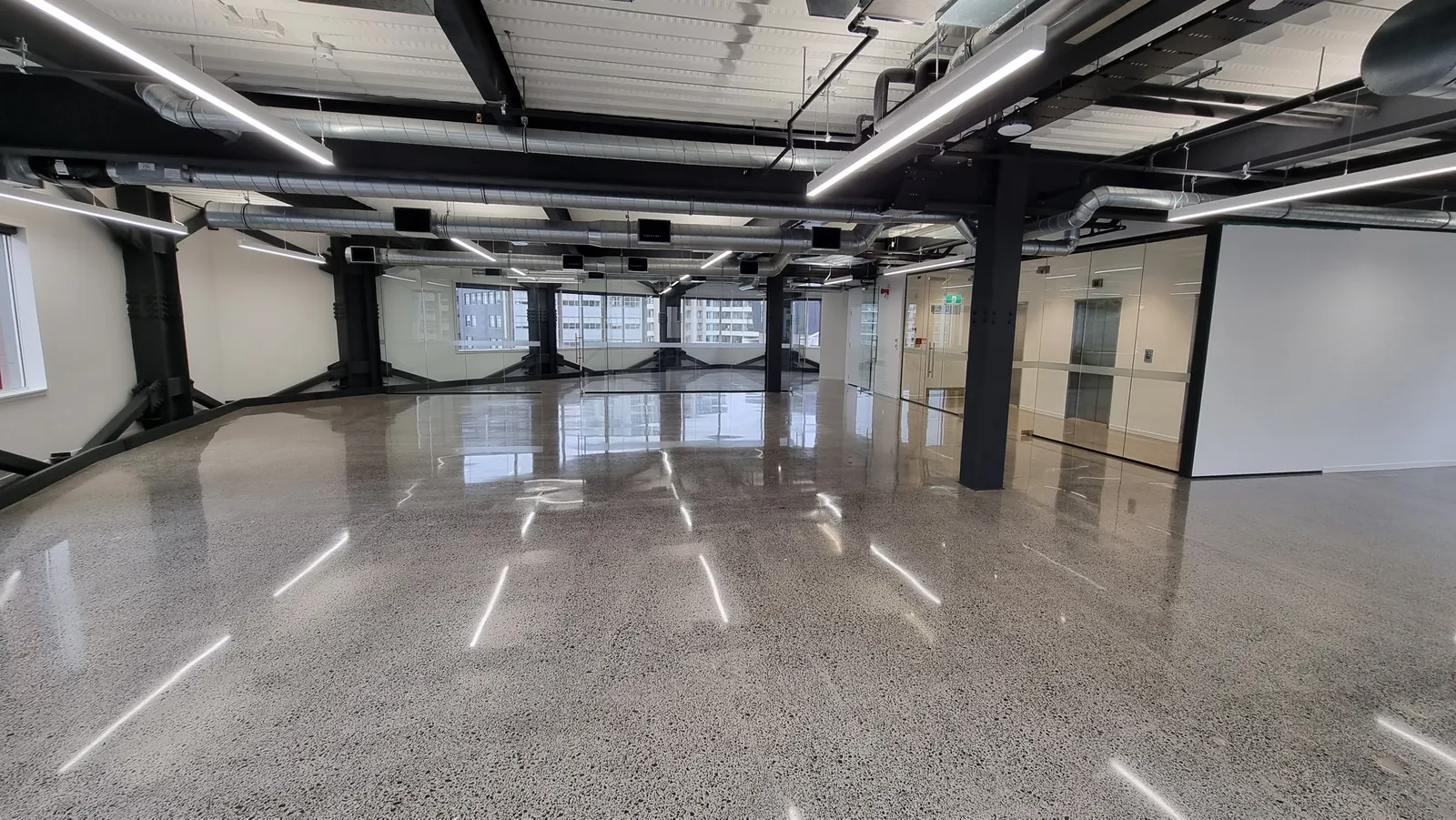
This article breaks down exactly why commercial operators are making the switch - the durability data, the maintenance savings, and the real NZ pricing that makes it a better long-term investment than tiles, vinyl, or coated alternatives.
Commercial Polished Concrete vs Other Commercial Flooring
The comparison is most visible over a 10-year period. Upfront costs are similar across most commercial flooring options. The difference is what happens after installation.
| Feature | Mechanically polished concrete | Vinyl/LVP | Ceramic tiles | Epoxy coating |
|---|---|---|---|---|
| Installed cost per m2 | $60-$100 + GST | $50-$80 | $80-$150 | $40-$70 |
| Lifespan | 20+ years with maintenance | 10-15 years | 20-30 years | 3-7 years |
| Maintenance | Mop + rebuff every 3-5 years | Replace worn sections | Regrout + replace cracked tiles | Strip and recoat every 3-5 years |
| 10-year total cost (1,000m2) | $80,000-$110,000 | $100,000-$160,000 | $120,000-$200,000 | $80,000-$140,000 |
| Trolley/forklift rated | Yes | Limited | No (grout cracks) | Yes (when fresh) |
| Downtime for maintenance | Hours (rebuff during off-hours) | Days (section replacement) | Days (retiling) | Days (strip, coat, cure) |
The lifetime cost advantage is significant for any commercial operator running a space larger than 200m2. The upfront investment is competitive, and the ongoing costs are dramatically lower.
Durability Under Real Commercial Traffic
Retail and warehouse floors see abuse that residential floors never encounter. Trolleys with hard rubber wheels, pallet jacks, forklifts, dropped stock, chemical spills, and hundreds of thousands of foot movements per year. Most flooring options degrade visibly under this load within 3-5 years.

Mechanically polished concrete handles this differently. The mechanical polishing process uses a lithium densifier that chemically hardens the concrete surface. The result is a floor that actually gets harder with use - foot traffic burnishes the surface rather than wearing it down. There is no coating to scratch through, no grout lines to crack, and no adhesive to fail.
DSC has polished floors in supermarkets, retail stores, and hospitality venues across Auckland that still look exceptional years after installation. The surface shows no wear patterns at checkout lanes, no scuffing at entrance mats, and no degradation in high-traffic aisles.
Maintenance Savings
This is where the commercial case becomes clear. A facilities manager's flooring budget is not just the installation - it is every dollar spent maintaining that floor over its life.
Polished concrete maintenance schedule (commercial)
- Daily: Auto-scrubber or dust mop (standard cleaning, same as any floor)
- Weekly: Wet clean with pH-neutral solution
- Every 3-5 years: Professional rebuff to restore surface gloss ($30-$50 per m2 + GST)
- Never: Recoating, stripping, retiling, or full replacement
Compare that to alternatives
- Vinyl: Worn sections need cutting out and replacing. Seams lift. Full replacement every 10-15 years.
- Tiles: Grout cracks under trolley traffic. Individual tiles chip and need replacing. Full regrout every 10-15 years.
- Epoxy: Coating peels and yellows under UV and heavy traffic. Full strip and recoat every 3-5 years. Floor is unusable during 48-72 hour curing.
For a 1,000m2 supermarket floor, the maintenance saving over 10 years can exceed $50,000 compared to epoxy or vinyl alternatives. That number grows every year the polished floor stays in service.

Slip Compliance for Commercial Spaces
Any floor in a public commercial space must meet NZ Building Code requirements for slip resistance. This is tested against AS/NZS 4586 and expressed as P-ratings (wet pendulum test) or R-ratings (ramp test).
Polished concrete in a satin or matte finish typically achieves P2-P3, which meets requirements for most retail and commercial applications. High-gloss finishes in wet-prone areas (entrance zones, produce sections) can be specified at a lower gloss level to maintain compliance.
DSC advises on the right finish level for each zone within a commercial space and can provide slip test certification where required. For a detailed breakdown of slip ratings by finish type, read our slip resistance guide.
Commercial Pricing in Auckland
Commercial polished concrete is priced per square metre, with rates dropping significantly for larger areas. The open, obstacle-free layouts typical of retail and warehouse spaces are the most efficient to polish.
| Floor size | Price per m2 (+ GST) | Typical application |
|---|---|---|
| 200-500m2 | $60-$80 | Small retail, cafe, showroom |
| 500-1,000m2 | $50-$70 | Medium retail, warehouse section |
| 1,000m2+ | $45-$65 | Supermarket, large warehouse, distribution centre |
These rates are for mechanically polished concrete. Grind and seal is available at lower upfront cost for spaces where periodic recoating is acceptable - typically warehouses and back-of-house areas. For a full comparison, read our grind and seal vs mechanically polished concrete guide.

Why Retail Operators Are Making the Switch
The shift to polished concrete in New Zealand retail is driven by three factors.
Lower lifetime cost. A single mechanical polish installation replaces 3-4 cycles of epoxy or vinyl over a 20-year lease. The numbers are straightforward - spend once, maintain cheaply, never replace.
Zero downtime for maintenance. A rebuff can be done overnight or during a scheduled closure. There is no curing time, no fumes, and no sections roped off. The floor is ready to trade on immediately after the rebuff is complete.
Aesthetics that improve with age. Unlike coatings that yellow or vinyl that scuffs, polished concrete develops a natural patina over time. The surface becomes smoother and more reflective with foot traffic, which is the opposite of how most flooring behaves.
For commercial operators evaluating their next floor specification, the question is not whether polished concrete works - it is whether you can justify the ongoing cost of alternatives that need replacing every few years.
If you are specifying a floor for a supermarket or large-format store, see our commercial concrete polishing service in Auckland for the sectors we cover, pricing, and slip compliance.
Frequently Asked Questions
How much does commercial polished concrete cost in Auckland?
For commercial spaces over 200m2, most projects sit between $45 and $80 per m2 + GST, depending on floor size and finish level. Larger open areas (1,000m2+) are the most cost-effective at $45-$65 per m2. These rates are for mechanically polished concrete. Grind and seal is available from $30-$50 per m2 for areas where periodic recoating is acceptable. For residential pricing, see our full pricing guide.
Can you polish an existing commercial floor?
Yes. Most existing commercial concrete slabs can be polished regardless of age or condition. Old warehouse floors, retail spaces with vinyl removed, and slabs that have been patched or repaired are all candidates. DSC assesses the slab condition during a free site visit and advises on what result to expect.
How long does commercial floor polishing take?
Timing depends on the floor size and access. A 500m2 retail space typically takes 3-5 days. A 1,000m2+ warehouse or supermarket may take 5-10 days. DSC can schedule work in stages to minimise disruption - for example, polishing half the floor while the other half remains operational.
Does polished concrete meet NZ slip requirements for public spaces?
Yes. Polished concrete in a matte or satin finish typically meets P2-P3 slip resistance ratings under AS/NZS 4586, which is adequate for most retail and commercial applications. DSC advises on the appropriate finish level for each area and can provide slip test certificates where required.
How does polished concrete handle forklift traffic?
Mechanically polished concrete is rated for forklift traffic. The lithium densifier hardens the surface beyond standard concrete, and the absence of any coating means there is nothing to scratch through or peel. Many of DSC's commercial installations include forklift-rated warehouse zones alongside polished retail areas.
What maintenance does a commercial polished floor need?
Daily auto-scrubbing or dust mopping (same as any commercial floor), weekly wet cleaning with a pH-neutral solution, and a professional rebuff every 3-5 years to restore surface gloss. The rebuff takes a few hours and can be scheduled overnight. There is no recoating, no curing time, and no downtime.


