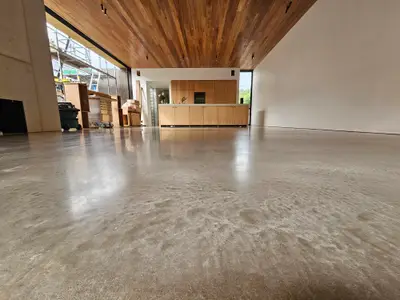
Yes. The sheen on a mechanically polished concrete floor can be changed, because sheen is created by how far the polishing grits are taken rather than by anything applied on top. Making a floor duller or glossier means reworking the surface mechanically across the whole floor. It is not a coating, and it is not a small job.

We get this call fairly regularly. Usually the floor is a few years old, the owner has lived with it through a couple of seasons, and it turns out to be shinier than they expected in the afternoon light. Occasionally it is the reverse and someone wants more life out of a flat floor.
The Sheen Ladder
Sheen is set by the grit the polishing process finishes at. There are five recognised levels.
| Sheen | Polishing grit |
|---|---|
| Matte | ~100 |
| Satin | ~200 |
| Semi gloss | ~400 |
| Gloss | ~800 |
| High gloss | ~1500 / 3000 |
Two things about this table matter more than the numbers.
Satin and semi gloss are distinct, adjacent levels. They are not two names for the same finish. Satin sits one step below semi gloss, and the difference is visible in person even though it is hard to see in photographs.
Sheen is subjective. What one person calls semi gloss, the next finds too glossy. Treat the grit numbers as a guide rather than a specification, and settle the decision by looking at a sample grind on your own floor in your own light. That is the only reliable way.
Sheen and Grind Level Are Two Different Choices
This is the thing that causes most of the confusion, so it is worth being explicit.
Grind level is how much stone is exposed. A light grind, which is what salt and pepper means, exposes only the very tops of the stones with the cement remaining as the background. A medium grind cuts deeper without chasing consistent large aggregate. A heavy grind removes significantly more material to fully expose the larger stones.
Sheen is how reflective the surface is, set by the final polishing grits.
They are independent. You can have a light grind at high gloss, or a heavy grind at matte, and any combination between. When someone says they want to change the finish, the first question we ask is which of the two they actually mean, because the answers are very different.
Changing sheen is a rework of the polishing stage. Changing grind level means cutting deeper into the slab, which is a bigger job and permanently changes the look of the floor.

Going From Glossy to Duller
This is the more common request, and it is straightforward in principle. The floor gets reworked and the polishing sequence stops earlier, at a lower grit.
The trade-off is worth understanding before you commit, because it runs the opposite way to what most people assume.
Matte is genuinely less slippery, which is usually why people want it. But matte is more susceptible to staining and visible wear. The surface is less closed, so spills mark more easily and traffic shows sooner. A matte floor asks more of you day to day than a satin or semi gloss one does.
That is why our default recommendation is satin to semi gloss as a range. It sits in the practical middle: enough grip, easier to keep looking good, and it does not throw glare across the room on a bright afternoon. If your complaint is glare rather than shine as such, dropping one step to satin often solves it without going all the way to matte.
Going From Dull to Glossier
Less common but perfectly possible. The polishing sequence continues up through the finer grits rather than stopping early.
The honest caveat is that the result depends on the concrete underneath. A higher sheen is less forgiving. It reflects more, which means it shows more of whatever is in the slab, including colour variation, patching, old repairs and any ghosting from a previous floor covering. A floor that looks calm at matte can look busier at gloss.
We do a sample grind before committing to this for exactly that reason.
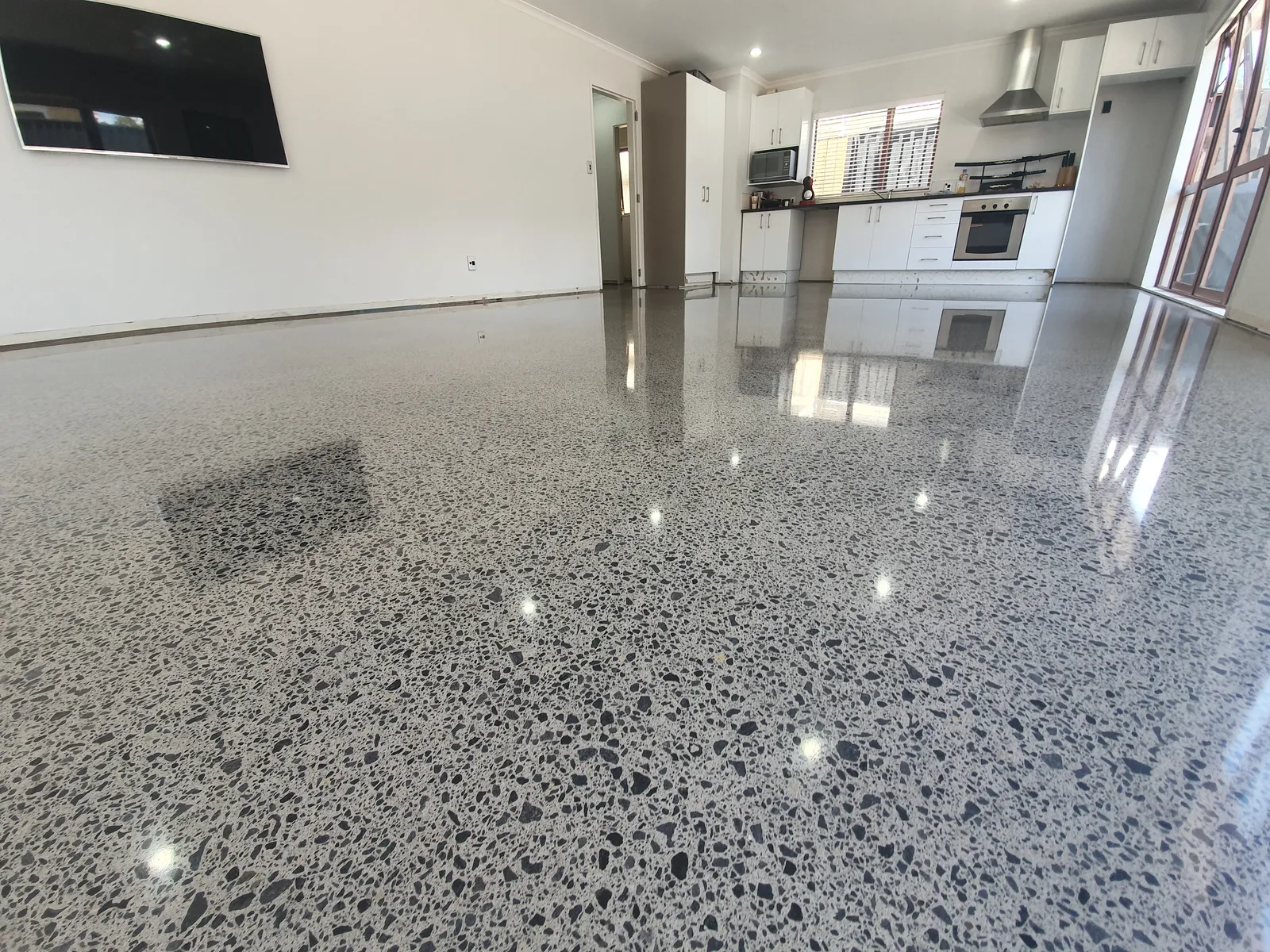
One Finish, Whole Floor
People sometimes ask about changing the sheen in one room only, or running matte through wet areas and something glossier through the living spaces.
We do not recommend it. In fourteen years Bowie has not done a mixed finish job. It reads as a mistake rather than a design decision, it creates a visible boundary in the middle of a house, and it leaves you with two different maintenance behaviours under one roof. For wet areas the better answer is mats and rugs where the water actually lands.
Where grip genuinely needs to be higher in a specific zone, the lever is a heavier grind in that area rather than a different sheen or any kind of additive. We do not use topical anti-slip additives, because our sealers penetrate rather than sitting on the surface as a film. All our finishes, including high gloss, pass the slip standards required in the commercial work we do.
There is more on this in our article on slip resistance and polished concrete.
What It Costs
Changing sheen means regrinding and repolishing an existing polished floor, which is priced as restoration work.
| Job | Price per m2 (+ GST) |
|---|---|
| Regrind and repolish an existing polished floor | $60-$100 |
| Rebuff, every 3-5 years | $30-$50 |
The distinction between those two rows is important, and it is where expectations sometimes need managing. A rebuff refreshes the existing sheen level on a floor that has dulled with traffic. It will not move the floor to a different point on the sheen ladder. Changing sheen is the restoration job.
For how this fits against the rest of DSC's pricing see our Auckland cost guide, and if your floor has genuinely deteriorated rather than simply being the wrong finish, our restoration cost guide is the more relevant read.
Is It Worth Doing?
Sometimes the honest answer is no.
If the floor is only a little glossier than you would like and it is otherwise in good condition, living with it for another season is a reasonable option. Floors dull slightly with normal traffic anyway, and a lot of people find the shine settles into something they stop noticing.
If it genuinely bothers you every day, it is fixable, and it is a smaller job than replacing the floor by any measure.
Send us a photo, ideally in the light that bothers you most, and we will tell you what is realistic. Get a free quote.
Frequently Asked Questions
How much does it cost to change the sheen on a polished concrete floor?
It is priced as a regrind and repolish of an existing polished floor, which runs $60-$100 per m2 + GST. A rebuff at $30-$50 per m2 + GST refreshes the existing sheen but will not change the finish level.
Can you make a polished concrete floor less shiny?
Yes. The floor is reworked and the polishing sequence stops at a lower grit. Bear in mind matte is more prone to staining and visible wear than satin or semi gloss, so it is a trade rather than a straight improvement.
Can you make a dull floor glossier?
Yes, by continuing the polishing sequence through finer grits. A higher sheen reflects more and therefore shows more of what is in the slab, including colour variation and old repairs, so we do a sample grind first.
Is changing the sheen the same as changing the grind level?
No. Sheen is how reflective the surface is. Grind level is how much stone is exposed. They are independent choices, and changing grind level is a bigger job because it means cutting deeper into the slab.
Can I have different finishes in different rooms?
We do not recommend it and we do not do it. It creates a visible boundary through the house and two different maintenance behaviours. For wet areas, use mats and rugs rather than changing the floor.
Is a coating or polish available to change the look instead?
Not from us. Anything applied on top of the concrete is a film that will eventually wear, scratch or peel. Sheen on a mechanically polished floor comes from the concrete itself, which is why it can be reworked rather than stripped.
How do I know which sheen I actually want?
Look at a sample grind on your own floor, in your own light, at the time of day that bothers you. Sheen is subjective and photographs are unreliable for it.