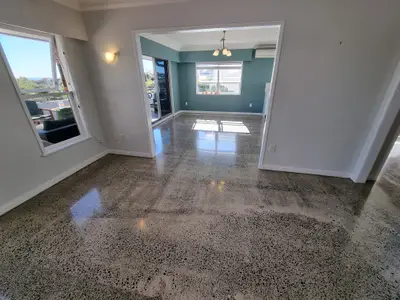
If your concrete floor is peeling, flaking or lifting in sheets, the sealer on it was a topical coating and it has lost its bond with the slab. Coatings cannot be patched successfully. The fix is to grind the failed coating off completely and mechanically polish the concrete underneath, which leaves nothing on the surface to fail again.
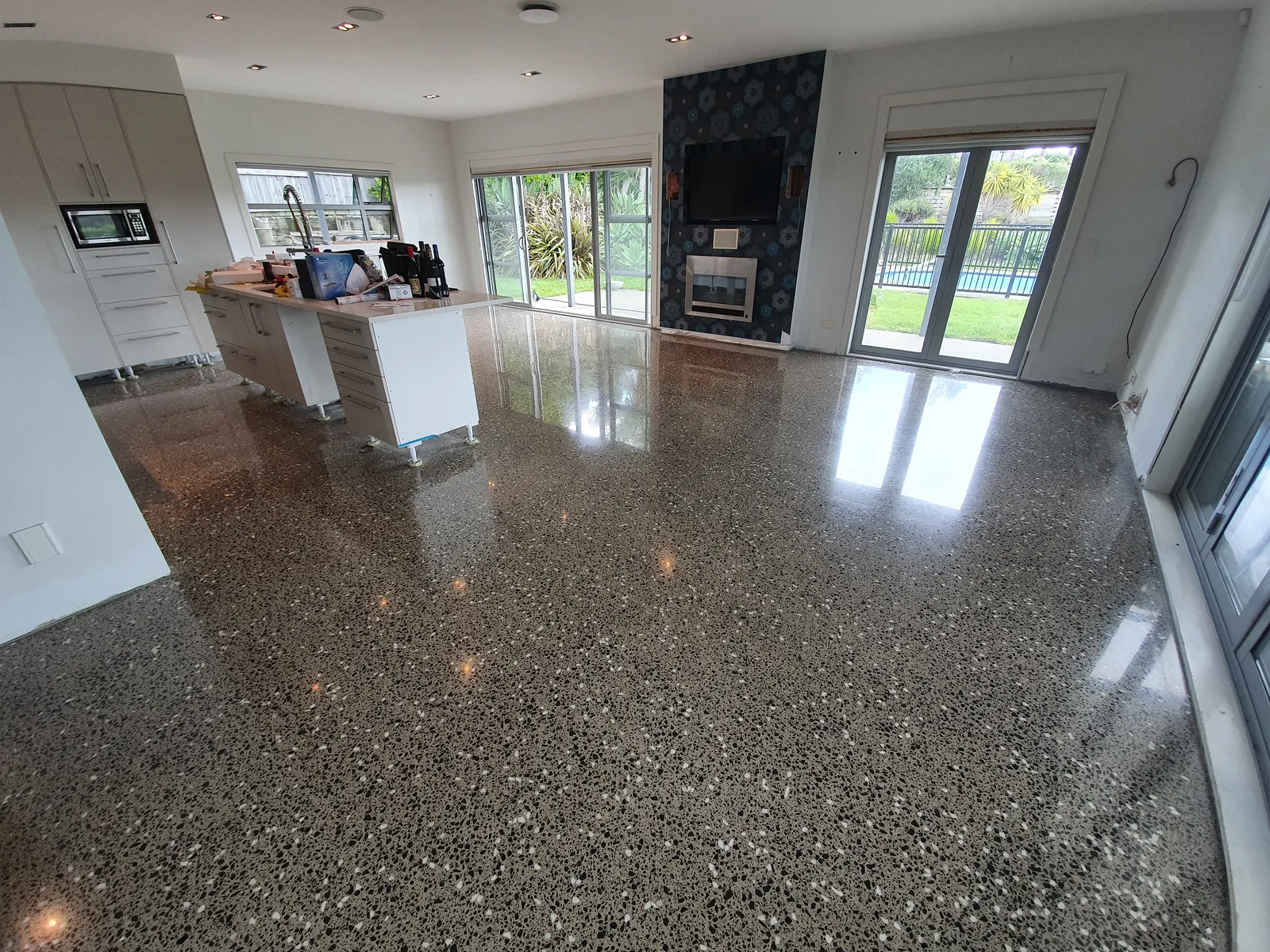
There is an important distinction underneath this question, and it decides everything about the fix. Not all sealers are the same thing, and the two main types fail in completely different ways.
Two Types of Sealer, Two Very Different Outcomes
| Topical coating | Penetrating sealer | |
|---|---|---|
| Where it sits | On top of the slab, as a film | Soaks into the concrete |
| How it fails | Peels, flakes, bubbles, lifts | Wears gradually, no peeling |
| Visible failure | Sudden and obvious | Slow dulling |
| Can it be patched | Not successfully | Not applicable |
| The fix | Grind it off entirely | Rebuff mechanically |
| Used by DSC | No | Yes |
Diamond Shine Concrete uses penetrating sealers only. The sealer soaks into the concrete rather than forming a film on top of it. That is the single reason a mechanically polished floor does not peel: there is no layer sitting on the surface for anything to delaminate from.
Everything in the peeling and flaking category comes from a topical coating, whether that is a garage floor paint, a DIY kit, or a coating applied by a previous contractor.
What Sealer Failure Actually Looks Like
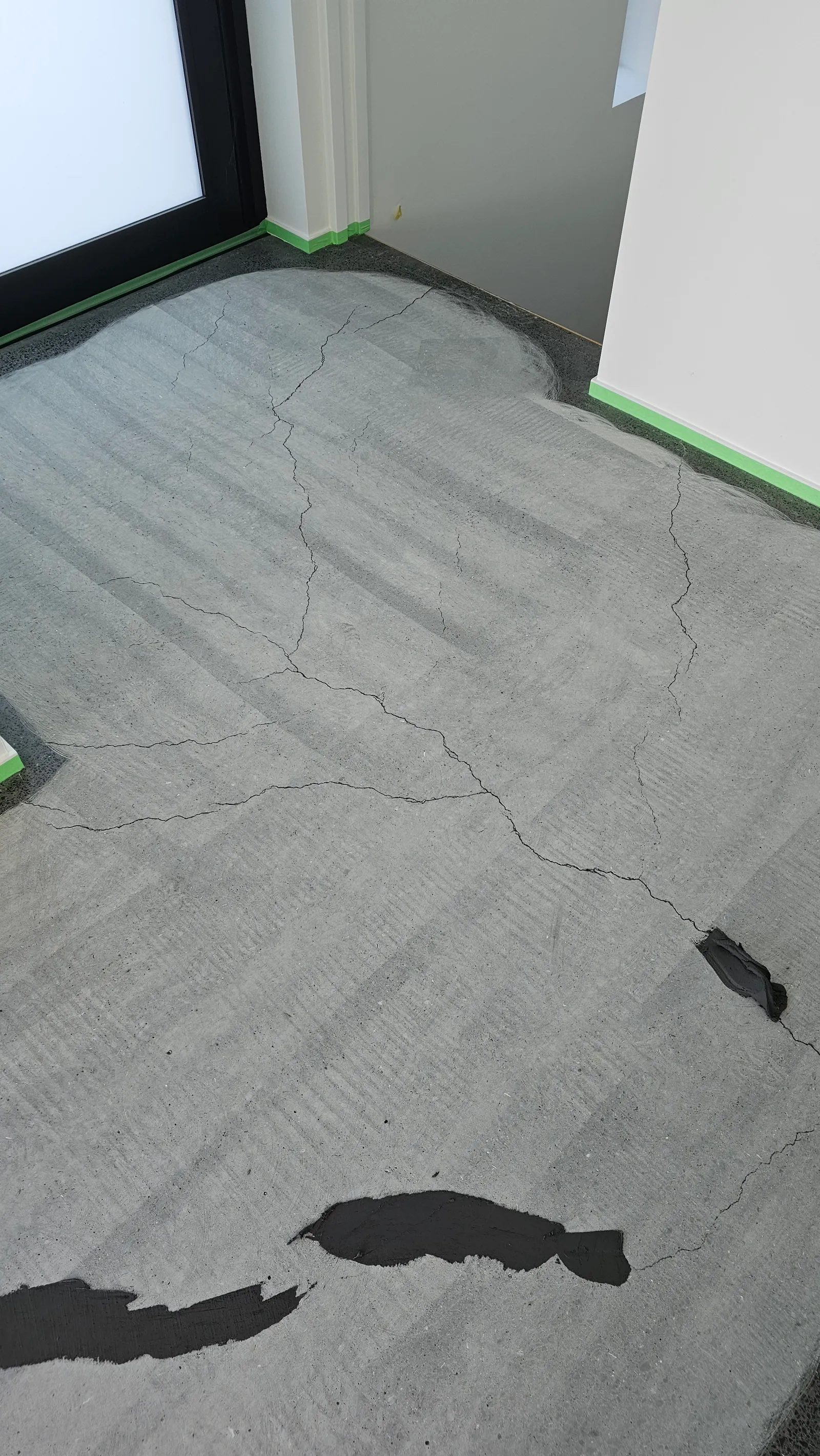
Peeling and flaking. Sheets or chips lifting away, usually starting at doorways, in sunlight, or wherever a car parks. This is a bond failure and it is terminal. Once a coating starts letting go, the rest follows.
Bubbling or blistering. Air or moisture trapped under the film. Often a sign the slab was not dry enough when the coating went on, or that moisture is coming up through the slab.
Cloudy or milky patches. Moisture caught under a coating. On a mechanically polished floor a cloudy appearance is a different problem with different causes, and we cover that separately in our guide to cloudy polished concrete.
Blotchy, uneven sheen. Often an application problem: the coating went on unevenly, or over a surface that was not properly prepared.
Yellowing. Some coatings discolour under UV, particularly near glass doors and windows.
Why Coatings Fail in the First Place
None of these are unusual. A coating is a consumable layer, and the question is when it fails rather than whether.
Moisture in the slab. The most common cause we see. Concrete holds and moves moisture. A film on top traps it, pressure builds underneath, and the bond gives way. Slabs without an effective moisture barrier underneath are particularly prone to it.
Poor preparation. A coating needs a properly ground, clean profile to key into. Applied over a smooth, dusty or contaminated surface it never really bonds in the first place.
Wear and heat. Traffic, hot tyres and UV all attack the film. Garages are the worst case because they combine all three.
Age. Coatings have a service life measured in years, not decades. Eventually they all need stripping and redoing, which is the recurring cost people do not expect when they choose one.
What Fixing It Involves
The honest answer is that a failed coating cannot be patched. Sanding back the loose edges and recoating a section leaves a visible boundary, and the surrounding coating carries on failing anyway. Every patched floor we get called to eventually needs doing properly.
Doing it properly means grinding the entire coating off, back to sound concrete, and then mechanically polishing the slab. The finish comes from the concrete itself, refined through progressively finer grits, and sealed with a penetrating sealer.
Two things worth knowing about that process.
Coating removal takes a heavier cut. Getting a film off adds machine time compared with a straightforward polish, which affects cost. Old adhesives and coatings smear under a light grind rather than coming away cleanly, so there is no shortcut here.
A heavier grind changes the look. Because the machine has to cut past the coating and into sound concrete, you will end up with more stone exposure than a light grind gives. Salt and pepper, which is the lightest grind with only the tops of the stones showing, is usually not achievable on a floor that has had a coating removed. Most people prefer the heavier exposure once they see it, because it hides the slab's history far better.

What It Costs
Removing a failed coating and polishing the floor underneath is priced as a renovation job rather than a new build polish, because of the extra preparation involved.
| Job | Price per m2 (+ GST) |
|---|---|
| Coating removal and polish, renovation | $90-$120 |
| Larger residential | $80-$100 |
| Single garage | $120-$140 |
| Double garage or larger | $100-$120 |
| Rebuff of a polished floor, every 3-5 years | $30-$50 |
The last row is the comparison that matters. A mechanically polished floor's ongoing maintenance is a periodic rebuff, not a strip and recoat cycle. That is the long term argument against coatings, and it is a cost difference that compounds over the life of the floor.
For the full pricing picture see our Auckland polished concrete cost guide.
What About a Polished Floor That Has Gone Dull?
Worth separating this out, because people often describe it as sealer failure and it is not.
A mechanically polished floor does not peel, but it does dull over time in traffic areas, in the same way timber or tiles do. That is wear, not failure. A polished floor lasts 20 or more years with good maintenance, and part of that maintenance is a rebuff every 3-5 years to mechanically bring the sheen back.
If your floor is dulling rather than peeling, that is normal ownership and a much smaller job. There is more detail in our article on why polished floors look dull after five years.
If you are not sure which one you are looking at, send us a photo. Peeling and wear look very different up close and we can usually tell straight away. Get a free quote.
Frequently Asked Questions
How much does it cost to remove a failed sealer and polish the floor?
Coating removal with a polish is priced as renovation work at $90-$120 per m2 + GST. A single garage runs $120-$140 per m2 + GST and a double garage or larger runs $100-$120 per m2 + GST.
Can a peeling sealer just be patched or recoated?
No, not successfully. The bond has failed and the surrounding coating will keep failing. Patching leaves a visible boundary and the floor needs doing properly later anyway, so it usually costs more in the end.
Does mechanically polished concrete need resealing?
Not in the way a coated floor does. The penetrating sealer soaks in during the polishing process rather than sitting on the surface. Ongoing maintenance is a mechanical rebuff every 3-5 years at $30-$50 per m2 + GST, not a strip and recoat.
Why did my sealer fail so quickly?
Moisture in the slab and inadequate preparation are the two most common reasons. A film on top of concrete traps moisture moving up through the slab, and pressure eventually breaks the bond. If the surface was not properly ground before coating, it never bonded well to begin with.
Will the floor look the same after the coating is removed?
Not exactly. Removing a coating needs a heavier cut, which exposes more of the stone in the concrete. A light salt and pepper look is generally not achievable afterwards. We do a sample grind on site so you can see how your slab responds before committing.
Is a cloudy floor the same as a failed sealer?
Not necessarily. Cloudiness under a coating is usually trapped moisture. Cloudiness on a mechanically polished floor has different causes, which we cover in our guide to cloudy polished concrete.
Internal Links Used
1. `/resources/polished-concrete-cloudy-fix` (cloudy floor diagnosis) 2. `/resources/polished-concrete-cost-auckland` (canonical pricing guide) 3. `/resources/polished-floors-dull-after-5-years` (wear vs failure) 4. `/get-a-quote` (conversion CTA)
Images Used
| Position | Catalog ID | Why selected |
|---|---|---|
| Hero / Thumb | `finished-home-referbs--20200929-141248` | Wide, after, semi-gloss polished floor. Shows the outcome rather than the problem, per the featured-image rule. |
| Failure signs | `cracks-and-joint-repairs--20240909-085652` | The only catalog image showing a coating visibly peeling. Literal match for the peeling and flaking section. |
| Fixing it | `light-grinds--20220216-132757` | Light grind close-up, used to illustrate the finish the reader will NOT get after coating removal. Supports the expectation-setting paragraph. |
Image gap flagged for Bowie: the catalog has essentially no photos of failed sealers or coatings. `cracks-and-joint-repairs--20240909-085652` is the only one and it is now used in two August articles. This article would be considerably stronger with two or three photos of genuine coating failure: peeling at a doorway, bubbling, and a mid-removal shot. Logged in the Bowie review file.
Review Notes
- Pricing: `$90-$120` (carpet removal / renovation), `$80-$100` (larger residential), `$120-$140` and `$100-$120` (garage note), `$30-$50` (rebuff). All canonical from `pricing-reference.md`.
- Bowie rules applied: grind and seal never presented as a DSC service or option anywhere in the article; the entire coating discussion is framed as what other people applied and what DSC removes; penetrating sealer explicitly contrasted with topical film; no epoxy named as a DSC service; "20+ years with good maintenance" phrasing; dulling framed as wear not failure; salt and pepper correctly defined as lightest grind and flagged as unachievable after coating removal; sample grind referenced.
- Positioning check: the comparison table has a "Used by DSC: No / Yes" row rather than a "when a coating makes sense" section, which keeps it on the right side of the 2026-05-28 correction. Worth Rheed confirming that reads as informative rather than as a swipe.