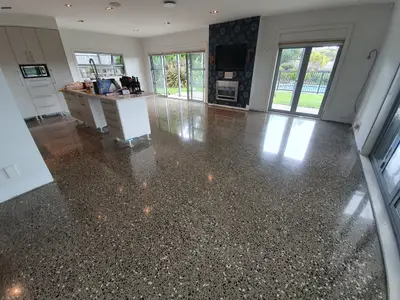
Most damaged concrete floors in Auckland can be repaired, and the repair is usually done as part of grinding and polishing the floor rather than as a separate patch job. For a typical residential floor, expect around $100 per m2 + GST for the full repair, grind, and polish, with cracks and joints filled as part of that scope.

If you are staring at a cracked, patchy, or worn concrete floor and wondering whether it can be saved and what saving it will cost, this guide walks through the damage we see most often across Auckland, how each type gets fixed, what the numbers look like, and where the honest limits are. We have ground and polished hundreds of floors across Auckland over the past 14 years, and most of them needed some repair work along the way.
What kind of damage can be repaired?
Nearly every older slab has something wrong with it. The question is rarely whether the floor can be repaired, but how much work the slab in front of us needs. Here is how the common types of damage stack up.
| Damage type | What it looks like | Can it be fixed? | Typical fix |
|---|---|---|---|
| Cracks | Hairline to structural cracks running across the slab | Yes | Filled, then ground and blended during polishing |
| Joint damage | Chipped or crumbling control and expansion joints | Yes | Cleaned out and filled with joint filler |
| Surface damage | Gouges, holes, tack strip marks, glue residue | Yes | Heavier grind to remove and blend |
| Patchiness and stains | Discolouration, old paint, uneven colour | Mostly | Grinding reduces and blends, rarely erases completely |
| Unevenness | High and low spots across the slab | Within limits | Grinding levels 3-5mm off high points, up to about 8mm |
| Severe damage | Crumbling, badly out-of-level, or failing slab | Sometimes | Concrete topping or overlay, then grind and polish |
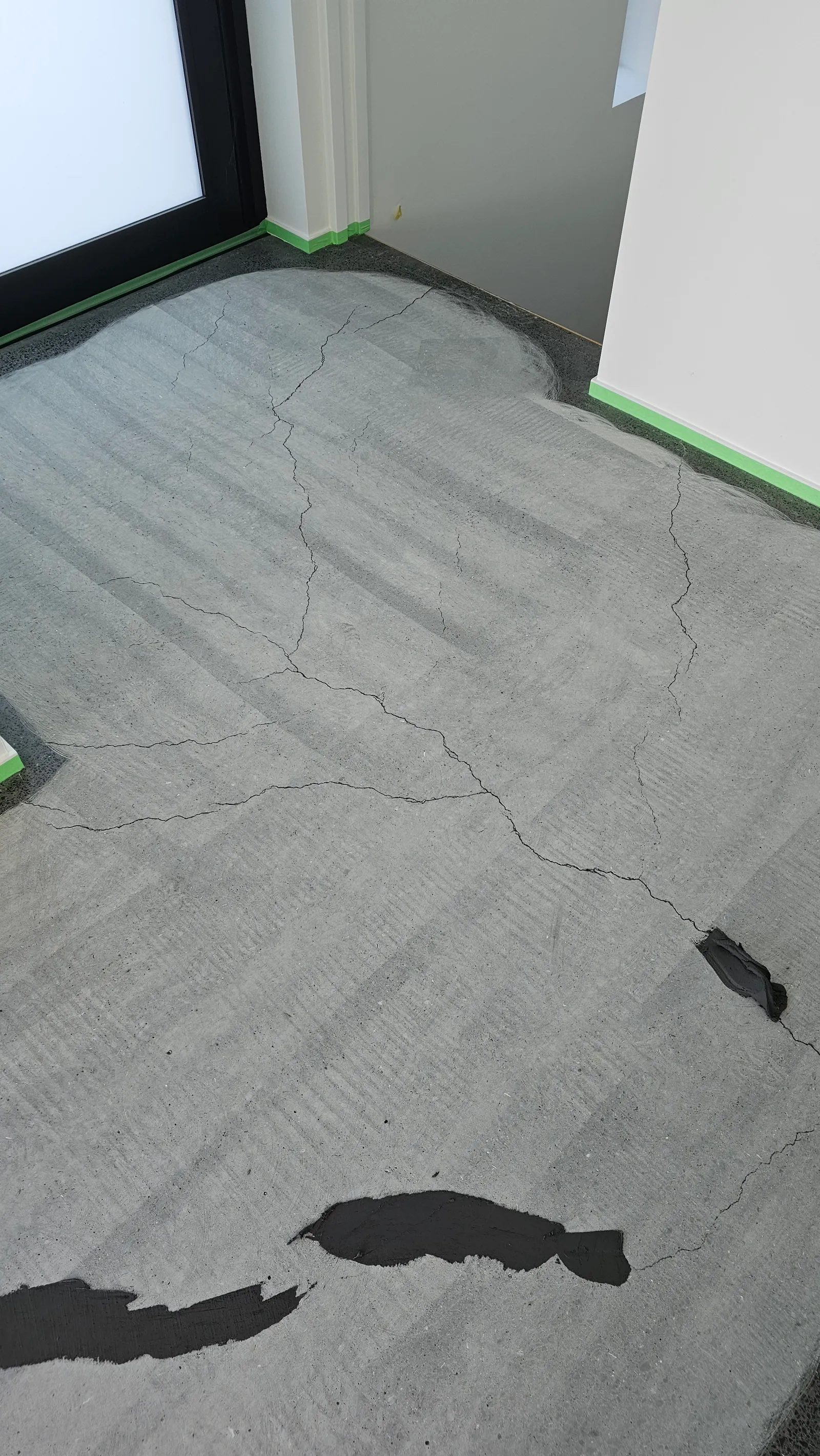
The one thing we always tell homeowners upfront: repair on a concrete floor means making damage far less visible and structurally sound, not making it vanish. Grinding blends and minimises cracks and marks. It does not erase them. A floor with character marks that have been properly filled and polished looks intentional. A floor that was promised "perfect" and delivered "improved" leads to disappointment, so we set expectations honestly from the first visit.
How concrete floor repair actually works
We do not turn up with a bag of patching compound and trowel over the damage. Repair is part of the grinding and polishing process, and doing it that way is what makes the result last.
Cracks and joints are filled first. Cracks get cleaned out and filled, and damaged control joints get the old material removed and refilled with proper joint filler. This happens before the main grind so the filler gets worked flat with the rest of the floor.
Grinding removes and blends the damage. Gouges, tack strip marks from old carpet, glue residue, and surface stains need a medium to heavy grind to cut past. Light grinding smears glue rather than removing it, which is why older renovation slabs almost always need a deeper cut.
Polishing brings the whole floor to one finish. After the repair and grind, the floor goes through the polishing grits to your chosen sheen and gets a penetrating sealer. Because the repairs were done before polishing, they blend into the finished surface instead of sitting on top of it.
We run the same process across the entire floor rather than spot-treating one corner, so you do not end up with an obvious repaired patch that catches the light differently. If you want the detail on crack repair specifically, our guide on repairing concrete cracks before polishing covers the process step by step.
What concrete floor repair costs in Auckland
Because repair happens as part of grinding and polishing, the honest way to price it is as a complete floor, not as a per-crack rate. Repair work is included in the scope we quote.
Typical residential floors (50-70m2) sit around $100 per m2 + GST including repair, grinding, and polishing. A 60m2 living area at $100 per m2 works out to roughly $6,000 + GST.
Larger residential floors (70-200m2) usually come in around $80-$100 per m2 + GST, because the setup cost spreads across more floor.
Renovation jobs with carpet or tile removal run $90-$120 per m2 + GST. Pulling up old coverings, dealing with glue and tack strip damage, and repairing what is underneath is more work than a clean slab.
Restoring an existing polished floor that has worn or been damaged costs $60-$100 per m2 + GST for a regrind and repolish.
Small floors under 20m2 carry a minimum charge of $2,250 + GST, because the machines, transport, and setup cost the same whether the floor is tiny or not.
The biggest variable is the condition of your slab. A floor with a few hairline cracks needs far less work than one with deep gouges and layers of old glue. That is why we look before we quote. For the full picture of what drives polished concrete pricing up or down, read our polished concrete cost guide for Auckland.
When repair alone is not enough
Some slabs are past the point where grinding and filling can save the surface. Two situations come up regularly.
Severe unevenness. Grinding handles mild to moderate unevenness comfortably, routinely taking 3-5mm off the high points and up to about 8mm where needed. Beyond that, grinding alone cannot level the floor. Our guide on uneven concrete slabs covers where the line sits.
Badly damaged or failing surfaces. Where a slab is crumbling or too far gone, the answer is a concrete topping or overlay: a structural layer of 25-50mm of new concrete poured over the old slab, which we then grind and polish once it has cured. It costs more than repairing the existing surface, but it delivers a genuinely new floor.
One thing we never do is polish over self-levelling compound. Our machines are heavy - even the lightest grinder is around 500kg - and running that weight over a few millimetres of weaker self-leveller leads to cracking and delamination. If a floor genuinely needs self-levelling compound, the realistic path is an alternative floor covering over the top, not polish. We would rather tell you that at the quote stage than sell you a floor that fails.
For the bigger question of whether a tired old slab can become a polished floor at all, see our guide on transforming an old or damaged concrete floor.
How we set expectations before any work starts
Every repair job starts with a look at the slab, and most start with a sample grind on site. We grind a small test patch so you can see exactly how your concrete responds: how much aggregate shows, how the cracks blend after filling, and what the colour variation looks like. You see the real result on your real floor before committing to the full job.

A properly repaired, ground, and polished floor should last 20+ years with good maintenance, with the odd rebuff along the way. That is the payoff for doing the repair as part of the polishing process rather than as a cosmetic patch: the fix is in the floor, not sitting on top of it waiting to peel.
If your floor is cracked, patchy, or worn and you want a straight answer on whether it can be saved, get a free quote and we will come and look at the slab. Our concrete grinding and polishing service page covers how the process works from first visit to final seal.
Frequently Asked Questions
How much does concrete floor repair cost in Auckland?
Repair is priced as part of a grinding and polishing scope rather than per crack. Typical residential floors of 50-70m2 sit around $100 per m2 + GST including repair work, larger floors run $80-$100 per m2 + GST, and renovation jobs with carpet or tile removal run $90-$120 per m2 + GST. A minimum charge of $2,250 + GST applies to floors under 20m2.
Can cracked concrete floors be polished?
Yes, in almost all cases. Cracks are cleaned out and filled before grinding, then blended into the surface during polishing. The cracks become far less visible and the filler sits flush with the floor, but grinding blends and minimises cracks rather than erasing them completely.
Do you repair concrete floors without polishing them?
Our repair work is done as part of grinding and polishing projects, because filling cracks and then grinding the floor is what makes the repair blend in and last. If your floor needs repair only, get in touch anyway and we will give you a straight answer on whether we are the right fit for the job.
Can grinding make cracks and marks disappear completely?
No, and anyone who promises that is overselling. Grinding and filling reduces, blends, and minimises damage, often to the point where visitors never notice it. Deep cracks and stains that run through the slab will still show faintly. We do a sample grind on site so you can see the honest result before the full job starts.
What if my floor is too damaged to repair and polish?
For severely damaged or badly out-of-level slabs, the option is a concrete topping or overlay: 25-50mm of new structural concrete over the old slab, ground and polished once cured. We do not polish over self-levelling compound, as our 500kg+ machines cause thin self-leveller layers to crack and delaminate.
How uneven can a floor be before grinding cannot fix it?
Grinding routinely takes 3-5mm off the high points and can handle up to about 8mm comfortably. Beyond that, levelling by grinding alone stops making sense, and a topping or an alternative floor covering becomes the better path.
Internal Links Used
1. `/resources/repair-cracks-before-polishing` (crack repair how-to - the process detail behind this cost page) 2. `/resources/polished-concrete-cost-auckland` (cost guide - full polishing price breakdown) 3. `/resources/uneven-concrete-slabs-grinding` (levelling limits) 4. `/resources/transform-old-damaged-concrete-floor` (can-it-be-done companion piece) 5. `/services/grinding-polishing` (service page - process and quote) 6. `/get-a-quote` (quote CTA)Images Used
| Position | Catalog ID | Why selected |
|---|---|---|
| Hero | `cracks-and-joint-repairs--20240910-155044` | After shot of a residential entrance floor post crack repair - literally shows the article subject, matches Bowie's subject-matching rule |
| Damage types | `cracks-and-joint-repairs--20240909-085652` | Before shot of genuinely cracked, damaged slab - shows the starting point readers have |
| How repair works | `cracks-and-joint-repairs--20240819-105353` | Mid-process crack and joint filling at a commercial venue - the repair stage itself |
| Setting expectations | `cracks-and-joint-repairs--20240823-065453` | Dramatic after shot of repaired and polished venue floor - the payoff image |