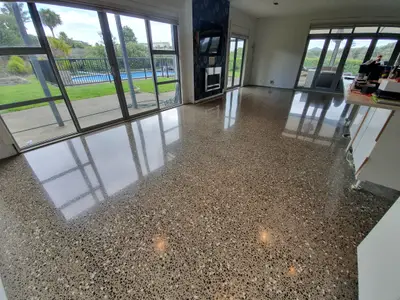
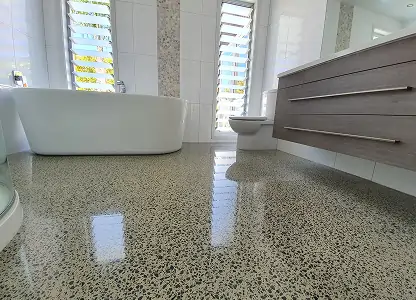
Polished concrete and underfloor heating are an excellent match. Concrete is one of the best thermal conductors in residential flooring - it picks up heat from underfloor systems quickly and holds it for hours after the system cycles off. NZ homeowners with both report warmer-feeling homes, lower running costs than ducted heating, and the lifestyle benefit of no cold spots underfoot. Here's how the two systems work together, what to spec during a build, and what to expect for your project.

About this guide. We polish over hydronic and electric underfloor heating systems regularly across Auckland new builds. The build-coordination advice here comes from 14 years of working alongside heating installers and is reviewed by Bowie Houston.
Last reviewed: May 2026 | Author: Bowie Houston, Director, Diamond Shine Concrete
We polish hundreds of new build floors across Auckland every year and underfloor heating is increasingly part of the spec. We don't install heating systems ourselves - that's a separate trade - but we polish over them constantly, and the system needs to be considered when we plan the polishing job.
Why the Two Systems Work So Well Together
Concrete has high thermal mass. That means it absorbs heat slowly, stores it, and releases it slowly. When you pair this with underfloor heating, the floor becomes a giant battery for warmth - the system runs, the slab gets warm, and even after it cycles off the floor stays warm for hours.
| Floor type | Thermal conductivity | Thermal mass | Result with underfloor heating |
|---|---|---|---|
| Polished concrete | Excellent | Very high | Warm floor, slow cooldown, efficient |
| Tiles on slab | Excellent | Medium-high | Similar warmth, slightly faster cooldown |
| Engineered timber | Poor-moderate | Low | Acceptable but inefficient - timber insulates |
| Carpet | Very poor | Low | Underfloor heating is wasted under carpet |
| Vinyl/laminate | Moderate | Low | Acceptable but not as effective as concrete |
For NZ homes, the combination delivers consistent warmth at lower running costs than systems where the floor surface insulates against the heat. The cold-floor problem people associate with concrete actually disappears - and the floor warms the whole room rather than just the air.
Two Types of Underfloor Heating to Know
NZ residential builds typically use one of two systems. The choice affects how the slab is poured and detailed.
Hydronic (water-based) underfloor heating
Hot water circulates through pipes embedded in the slab. A heat pump or boiler heats the water. The pipes sit in a reinforced position within the slab thickness during the pour.
Pros: Lowest running cost (heat pump efficiency). Can run from solar/cylinder hot water. Even heat distribution. Cons: More expensive to install. Requires an unfinished plant area for the pump and manifolds. Must be planned at slab pour stage - can't be retrofitted into an existing slab.
Electric resistance underfloor heating
Electric heating elements (cables or mats) embedded in or laid over the slab. Wired to the home electrical system, controlled by a thermostat.
Pros: Cheaper to install. Can be added later (over an existing slab with a self-levelling overlay). Faster to warm up. Cons: Higher running cost (especially for whole-home use). Less even heat distribution if cables are spaced too widely.
For new builds, hydronic is the better long-term choice if budget allows. For renovations or smaller zones (bathroom, kitchen only), electric is more practical.
How Polishing Works Over Underfloor Heating
The good news: we polish over both systems all the time. The system installer pours/installs the heating before the slab is finished. By the time we arrive to grind and polish, the heating is fully embedded and protected by the concrete above it.
Things to coordinate during the build:
1. Pipe depth must be sufficient for the depth of grind we'll do. For a heavy grind (taking up to 5mm off), pipes need to sit at least 25-30mm below the surface to be safely below our grinding depth. Hydronic installers know this and spec accordingly.
2. Test the system before polishing. The heating system should be commissioned and tested BEFORE we polish. If a leak or fault is detected after polishing, repair work damages the polished surface. Always do this in the right order: install heating → test → polish.
3. Don't run the heating while we polish. Wet grinding water on an active heating element is bad news. The system stays off during polishing and for 24 hours after.
4. Allow drying time before turning the system on. After polishing, we use water in the grinding process. The slab is essentially fully sealed by polishing, but allowing 48 hours after polish completion before activating heating gives water time to fully dissipate.
How the Floor Feels Day to Day
This is the question most homeowners actually want answered: what does it feel like to live with?
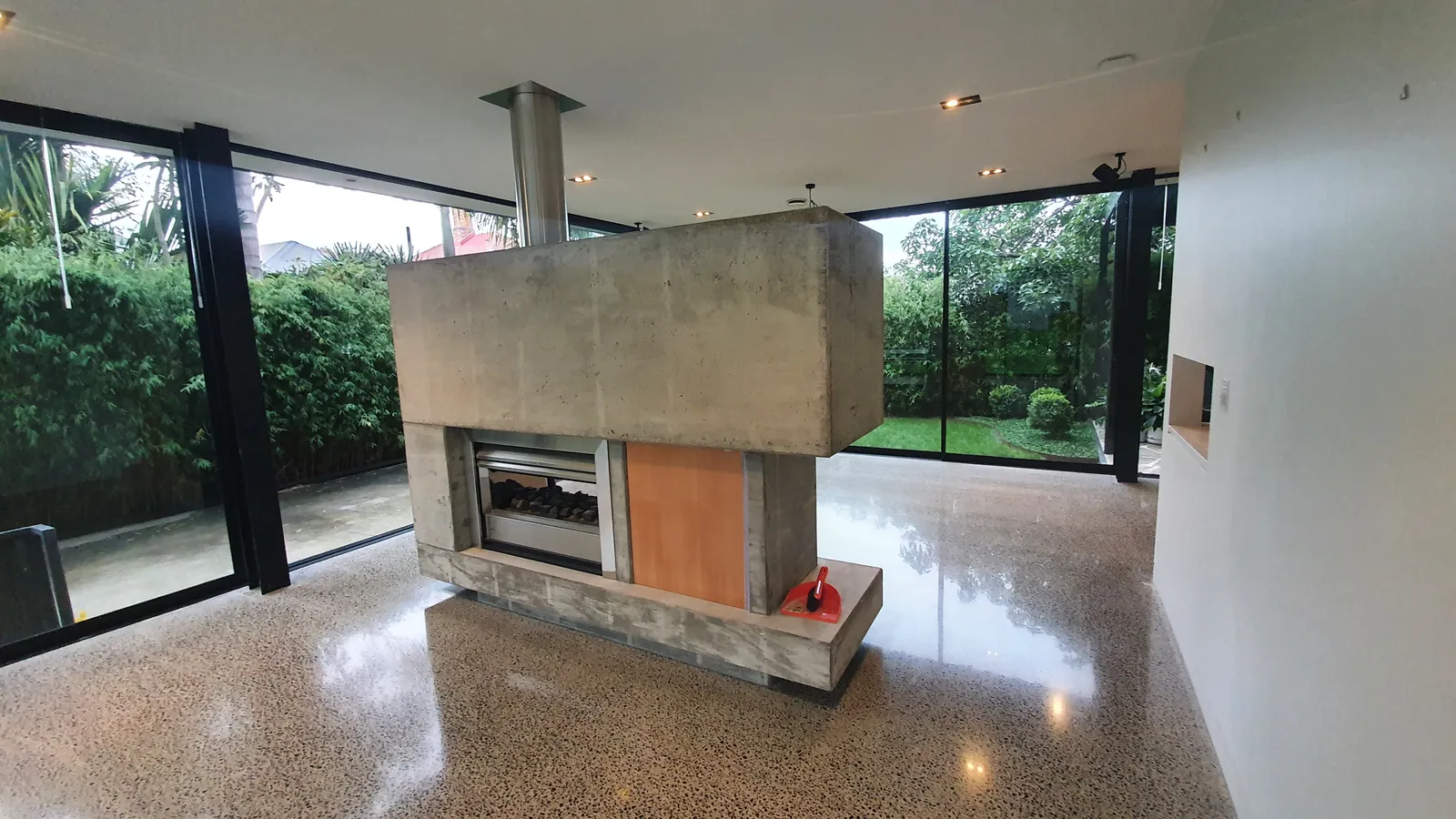
With heating on. The floor reads warm to the touch all over. Not hot - heated underfloor systems run at around 28-30C surface temperature. Walking around in bare feet feels comfortable in winter, similar to a warm timber floor.
With heating off. Polished concrete still feels cooler than carpet or timber, but the cold-floor problem is largely solved. The slab retains residual warmth for hours after the system cycles off.
In summer. Most homeowners turn the heating off entirely in summer. The floor returns to its natural cool feel - which is actually pleasant in NZ summers. We get more thank-you messages about cool concrete in February than complaints about cold concrete in July.
For more on thermal comfort generally, see our cold concrete floor article.
What to Spec for the Build
For new builds with underfloor heating planned:
Talk to your concrete layer and heating installer about pipe depth. They need to know we'll be grinding 3-5mm off the surface, so pipes need to be safely below that.
Polish before paint, ideally before plaster. Same as any new build polish job. The heating doesn't change the timing - we cover this in our build timing article.
Don't lay carpet or rugs over the polished concrete. Carpet insulates the floor and defeats the heating system. If you want soft zones (bedroom, lounge sitting area), use furniture pads and large area rugs only in spots where the heating coverage is less critical.
Spec a thermostat with floor sensor. Floor temperature sensors give better control than air-temperature thermostats. Most quality systems include this option.
Plan the polishing slot in the build programme. Underfloor heating doesn't change the timing rule for polishing - we still need to come in after the house is weathertight and gib lined, before paint, ideally before plaster. See our build timing guide for the full sequence.
What This Costs in Auckland
The polishing cost doesn't change because of underfloor heating. The slab still gets polished using the same process and the same pricing applies:
| Job type | Price per m2 (+ GST) |
|---|---|
| Average residential (50-70m2) | ~$100 |
| Larger residential (70-200m2) | $80-$100 |
| Large open (200m2+) | ~$60 |
What does cost extra is the heating system itself - hydronic systems run $80-130 per m2 installed (excluding heat pump and plant), electric systems $50-80 per m2 + electrician costs. Get a heating quote separately from your polishing quote. Our pricing guide for polished concrete covers the polishing side in detail.
Frequently Asked Questions
Does polished concrete work with underfloor heating?
Yes - it's one of the best floor surfaces for underfloor heating. Concrete's high thermal mass and conductivity make it efficient at picking up and storing heat from the system. Carpets, timber, and laminates all insulate against the heating; concrete amplifies it.
Can I add underfloor heating to an existing polished concrete floor?
Hydronic systems can't be retrofitted - the pipes must be in the slab itself. Electric systems can be added by laying mats over the existing slab and pouring a self-levelling compound over them, then re-polishing the new surface. The overlay alone adds $40-$60 per m2 + GST to a standard polish, plus the electric heating system at $50-$80 per m2 + electrician. Get a custom quote - retrofits vary significantly by site.
How much does polished concrete with underfloor heating cost in Auckland?
The polishing portion is ~$100 per m2 + GST for an average residential job (or $80-$100 per m2 on a larger 100m2 floor). The hydronic heating system is $80-130 per m2 + plant costs. Total for both, on a 100m2 floor, lands around $180-$230 per m2 + GST including heating installation. See our pricing guide for polishing detail.
Will the heating system be damaged when you polish?
No, when the build sequence is correct. The heating pipes/cables sit at least 25-30mm below the surface and we grind 3-5mm. The heating system is also tested before polishing, and we polish with the system OFF and after grinding water has fully dissipated.
How long does the floor stay warm after the heating cycles off?
Several hours, depending on how cold the room is and how much thermal mass the slab has. For a typical 100mm thick polished slab with hydronic heating, the floor stays comfortably warm for 4-6 hours after the system cycles off.
Is polished concrete still cold without underfloor heating?
It's cooler than timber or carpet but rarely as cold as people fear. Most homes manage well without heating in living areas. Bedrooms tend to be the coldest concrete zones - underfloor heating is most worth it in main bedrooms and bathrooms if not whole-home. We cover thermal comfort in detail in our cold floor article.
What finish should we use for a heated polished concrete floor?
We recommend a satin to semi-gloss finish as our default for any whole-floor polish, including heated floors. The finish doesn't change because of heating - same look, same wear, same maintenance. Don't mix finishes across rooms.
Talk to Diamond Shine Concrete
Planning a new build with underfloor heating and polished concrete? We've polished hundreds of residential and commercial floors across Auckland, the North Shore, East Auckland, West Auckland, and South Auckland. Have a look at our grinding and polishing services for the full process and what's included, or get in touch for a free site visit and quote.